


HATAY—Three years after twin earthquakes struck southern Turkey, many homes and urban centers have been rebuilt, but a return to normalcy continues to evade locals who struggle with limited job prospects.
While official statistics indicate the number of insured workers has returned to pre-quake levels in the impacted areas, they mask a shift in job quality. The region has seen a rise in low-productivity, often informal service jobs and temporary construction work, while the return of high-value professions has lagged behind in the recovery process.
The resulting challenges compound survivors’ sense of loss and grief from the magnitude 7.7 and 7.6 earthquakes on Feb. 6, 2023, which killed more than 53,000 people and destroyed urban areas.
“There’s nothing left of my life before the earthquake,” said Ayla, a 34-year-old Hatay resident who requested the use of an alias.
Ayla has four university degrees and works part-time at a printing house where she folds cardboard for about 20 dollars per day without insurance.
“It’s very difficult to find a job,” she said. “A column broke my mother’s back during the earthquake, and I have to look after her, as well.”
She lost her sister and father in the disaster, and said her mother currently receives 2,000 liras (about 45 dollars) per month as her allowance due to her husband’s death.
Combined with what Ayla makes at the printing house, it’s nearly impossible for them to get by under Turkey’s crushing inflation, which stands at over 30 percent officially and above 53 percent, according to independent researchers.
Recovery by the numbers
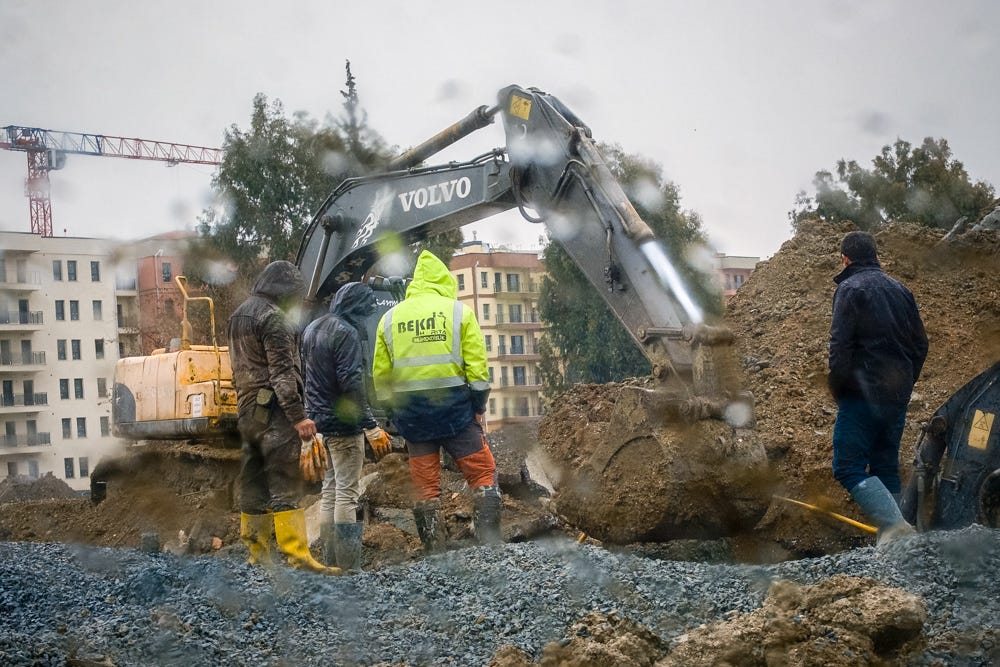
While the physical skyline of Hatay is defined by cranes, the economic landscape remains depressed. Nationwide, unemployment stood at 2.7 million in December 2025, according to official statistics.
In the earthquake region, which covers 11 provinces in southern and southeastern Turkey, labor force participation rates across the region are lower than the national average, while the unemployment rate is higher.
According to a new report from the Turkish Presidential Strategy and Budget Directorate, the 2024 labor force participation rate in the quake zone was 49.2 percent (vs. 54.2 percent nationally), and the employment rate is 44.2 percent (vs. 49.5 percent nationally).
Likewise, Hatay’s unemployment rate of 12.0 percent exceeded the national average of 8.7 percent in 2024. In this volatile environment, Ayla is hoping to get a job at the municipality, but said that “it’s a must” to know someone inside to secure a position.
“I’m broken to pieces,” she said. “The losses in my family, in my city … I’m giving a fight every day. The jobs out there are mostly based in construction.”
Speaking in December 2025, Minister of Labor and Social Security Vedat Işıkhan said the government has activated numerous programs and unemployment benefits “to ensure our citizens’ livelihoods, prevent the closure of workplaces and keep our people linked to production” in the earthquake zone.
He also added the number of employed individuals had risen “above pre-earthquake levels” in the region. The Ministry of Labor and Social Security did not reply to a request for further details in time for the publication of this report.
Youth employment
Süleyman Rende, a 28-year-old graduate student who is fluent in four languages, has also faced difficult job prospects in post-quake Hatay.
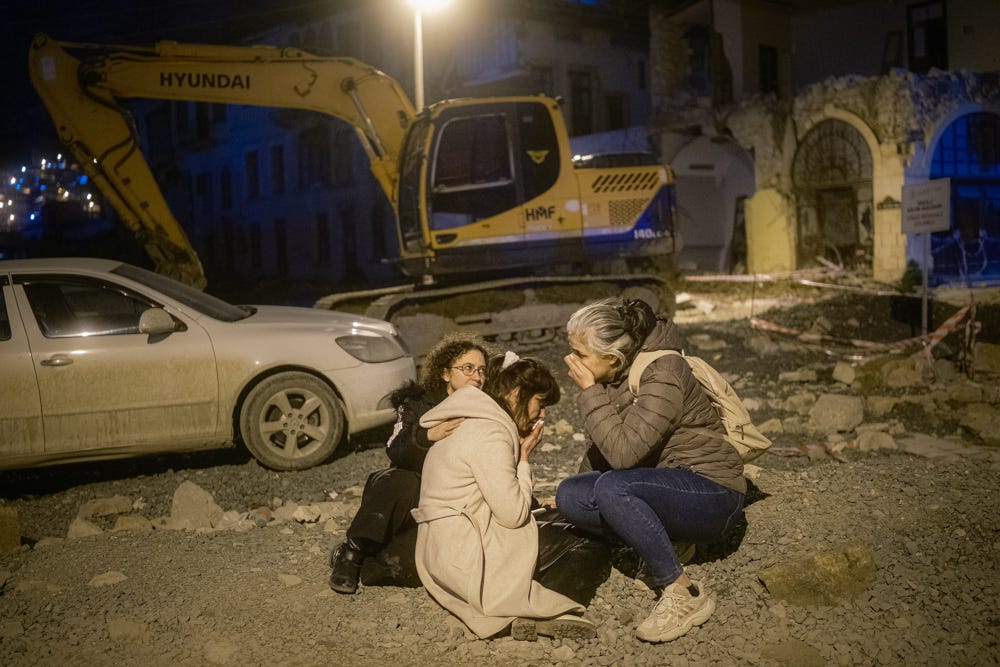
“Since the earthquake, I’ve worked in construction, used a forklift, worked as cleaning personnel,” he told Turkey recap. “But having the education and the certificates that I have, I felt out of place in those jobs.”
Rende lives with his parents and said it’s unsettling to receive economic support from his father, who’s also looking after his two younger siblings.
Many of the businesses shut down completely or shrunk after the earthquakes, he explained, adding the ones that remain tend to employ their relatives.
With bitterness, he’s considering leaving his hometown for Istanbul. He said he knows the cost of living will be even worse there, but the city may also provide more job options.
Mehmet Emin Doğruel, the Hatay representative of the Confederation of Progressive Labor Unions of Turkey (DISK), said that Rende’s experience is not an outlier.
“There are many people who are well educated and are working in construction right now in Hatay,” he said, underlining that the educated especially have a hard time “because they are not used to it.”
Accessibility issues
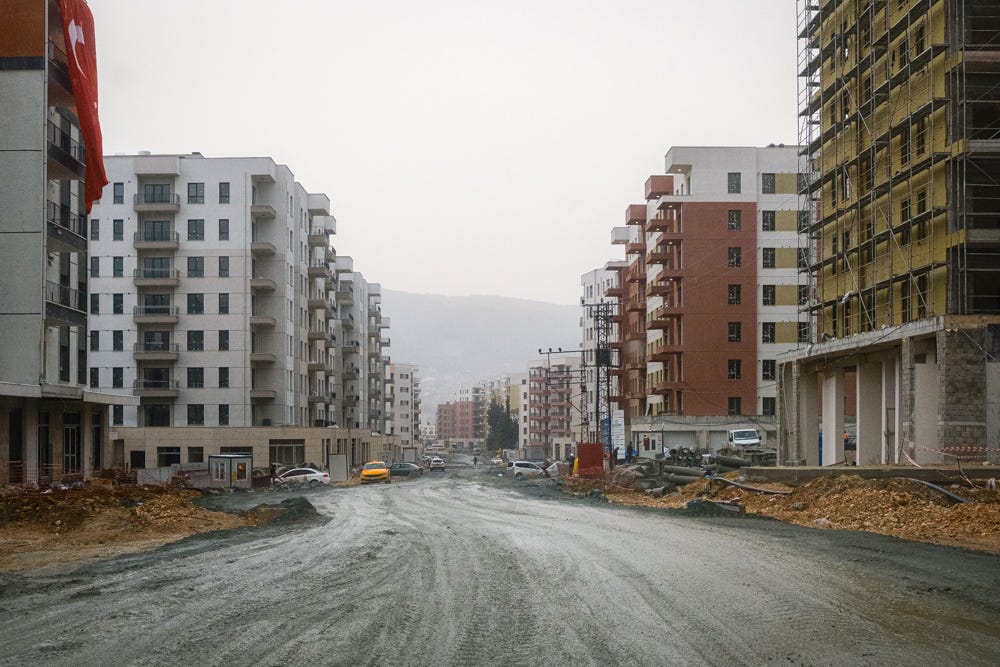
Often the site of poor working conditions and late payments, construction projects have become hot cash centers for Hatay’s unemployed. Still, the sector is not available as an option for everyone, including women and the elderly or disabled.
Zehra, a 28-year-old beauty expert who gave a pseudonym, said she has not been employed since Feb. 6.
She was trapped under the rubble with her family when her home collapsed in the earthquakes and one of her legs was amputated after she was rescued.
“The jobs I find, such as cashier, are only employing people who are standing during their shifts,” she said. “I was just about to get a position, but they wanted someone who could stand.”
At the moment, she is trying to get by on her husband’s salary from a restaurant. But, like many locals who spoke to Turkey recap say, it’s not enough. Zehra lives in a shipping container and said she often feels suffocated by her lack of options. She’s also not sure her conditions will improve if she does find employment.
“Without a private car, I can’t travel,” she said. “There are infrequent buses around the city, but no bus after six, seven pm. And even if you’re not an amputee, there’s no space to walk for a pedestrian.”
In late 2024, the Hatay Metropolitan Municipality launched a project called HAKIM, which stands for Hatay Center for Career and Employment, in collaboration with Hatay Governor’s Office and other official units.
The center is meant to bring employers and job seekers together, and provide courses to equip job seekers with relevant training and education. The Hatay Metropolitan Municipality, which is run by the ruling Justice and Development Party (AKP), did not reply to requests for comment before the publication of this report.
Closing up shop
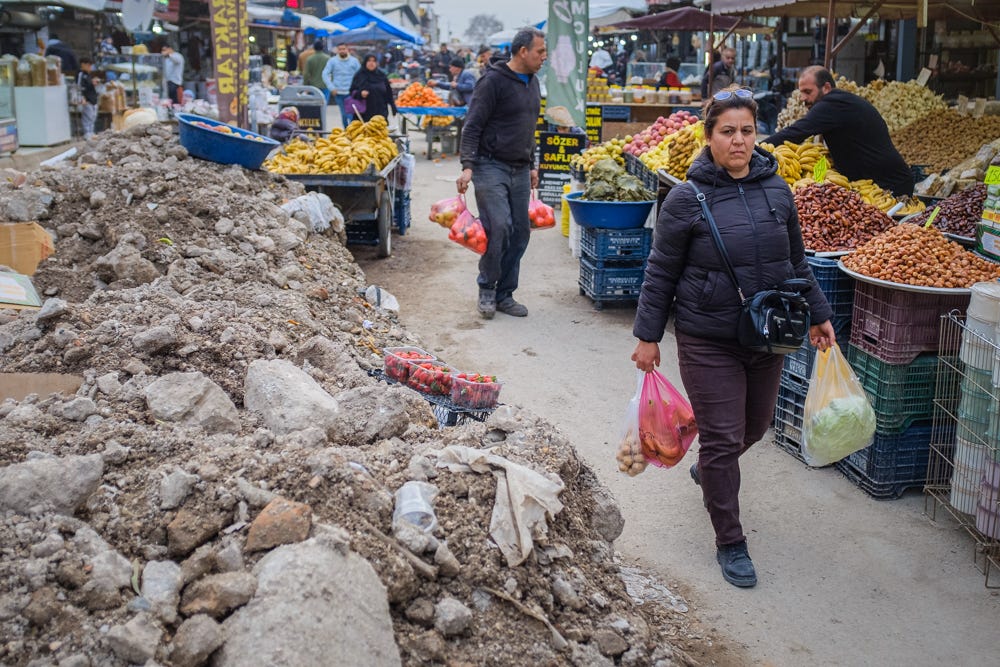
It’s a dusty city with survivors hustling through the mud, and children hitchhiking to school. A melting pot for numerous cultures including Turks, Christians and Arabs, Hatay’s old façade with lively narrow streets and vibrant marketplaces is long gone, replaced by rubble and construction.
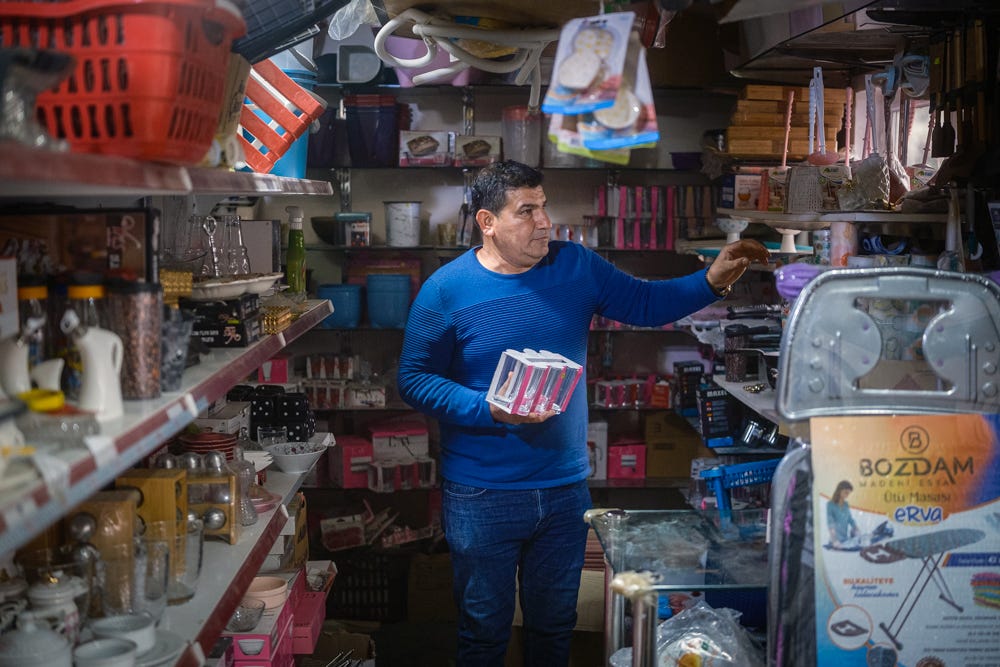
Inside his tiny shop in a shipping container, Ahmet Azazlıoğlu said he’s lost his ‘joie de vivre’. Like many locals, he lists off the difficulties of inhabiting a city that’s basically a giant construction site. He then added he’d be happy if he received more than one customer in a day.
“I decided to close the shop,” he said with a broken smile.
Azazlıoğlu has been selling kitchen utilities and glasses, but it hasn’t worked out for him. The shop is part of an open-air shopping center organized by the Istanbul Governor’s Office and AFAD, Turkey’s disaster and emergency response agency.
Yet, Azazlıoğlu said it’s difficult for customers to find the correct road to his shopping area amid the surrounding reconstruction projects. A piece of cardboard hangs outside his shop with the words “Liquidation clearance” written in marker.
“Ever since the earthquakes, daily life has become unbearable,” said Azazlıoğlu, who has three daughters and a wife.
“My shop used to be 160 square meters, located very centrally. It was the apple of my eye,” he said. “I used to have two workers, and paid every bill on time.”
“Now, I don’t even know what to pay with what. I have more than 300,000 liras in debt,” he said, adding he did not know how he would repay it.
“Here, we don’t know anything beyond today,” he said.
Turkey recap is an independent, reader-supported newsletter that helps people make sense of the fast-paced Turkey news cycle. Contact us: info@turkeyrecap.com.
Subscribe here on Substack (or on Patreon for discount options). Paid subscribers get full access to our recaps, reports, members-only chat and news tracking tools.
We are an affiliate of the Global Forum for Media Development and aim to produce balanced news that strengthens local media by supporting journalists in Turkey.
Diego Cupolo, Editor-in-chief
Emily Rice Johnson, Deputy editor
Ceren Bayar, Parliament correspondent
Yıldız Yazıcıoğlu, Parliament correspondent
Günsu Durak, Stüdyo recap editor
Demet Şöhret, Social media and content manager
 | A guest post by
|