

Op-ed | Exposing repression is only half the battle for Turkey's opposition
Turkey’s system of ‘rule by replacement’ is becoming easier to recognize. My survey experiment suggests how — and why that is still not enough for the opposition.

A court ruling in May reinstalled Kemal Kılıçdaroğlu as chair of the Republican People’s Party (CHP) amid increasing judicial attacks against opposition officials and municipalities.
In response, ousted CHP leader Özgür Özel formed the Yeni Party in July with 90 other MPs who broke away from Turkey’s main opposition party.
With 91 seats, Yeni Party immediately became the second-largest party in parliament, while the CHP fell to 44 MPs. Moreover, several recent polls now place the Yeni Party as voters’ first choice, ahead of the ruling Justice and Development Party (AKP), as support for the CHP plummeted to single digits.
Looking at this sequence, one might conclude the intervention in the CHP has backfired. Instead of producing a weaker opposition, it appears—at least for now—to have helped produce a stronger one.
There may be some truth to that, but my research gives us reasons to be more cautious: recognizing repression is not the same as rejecting it.
What counts as a kayyım?
When Kılıçdaroğlu returned to the CHP leadership, the word many opponents immediately reached for was kayyım (a state-appointed trustee), although the term was not technically accurate.
Legally, a court restoring a former party leadership is not the same procedure as the government removing an elected mayor and appointing a trustee in their place.
Politically, however, people recognized a resemblance. In both cases, a chosen leader of an institution is overridden by an outside authority, and somebody else ends up running it. That the resemblance came so easily is also indicative of low public confidence in judicial independence.
Even though the legal mechanisms are different, the public vocabulary is often what counts.
Governing through intermediaries works partly because an intervention can be presented as an ordinary legal or administrative decision rather than an act of political control. Once people begin to see different interventions as variations of the same practice, however, that political cover becomes harder to maintain.
When the disguise stops working
These different forms of rule by replacement (kayyım or the like) can achieve two things at once. Most obviously, they transfer control of an institution from someone elected (or internally chosen) to someone installed from outside. More subtly, they can create distance between political power and the coercive decisions that follow.
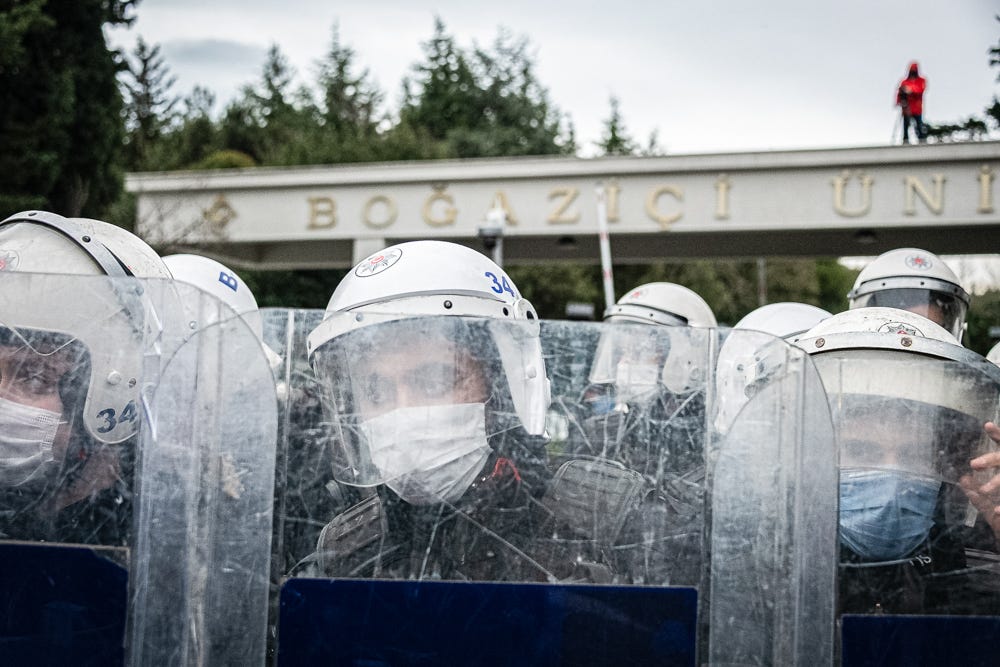
In that regard, when Melih Bulu was appointed rector of Boğaziçi University in 2021 by presidential decree, I wrote a policy brief describing the government’s approach to universities as a form of “smart repression.” Again, the word students reached for was “kayyım rector.”
The basic idea is simple. By delegating repressive authority to an installed trustee through means that appear administrative or legal, the government may keep its hands clean of the repression that follows.
That is to say, instead of directly deciding which academics can be hired, which student groups can operate, or which protests can take place, political authorities can appoint someone to make those decisions.
The coercion remains, but the government’s fingerprints become harder to see.
Measuring the limits of disguise
Earlier this year, in January, I tested one part of that logic in a survey experiment in Turkey, followed by comparable studies in Hungary and Slovakia between March and June, resulting in a total sample of 5,200 people across the three countries. Around 2,000 people in Turkey read a short news story about students protesting at a university in Ankara.
Everyone saw essentially the same hypothetical scenario concerning a student protest and a ban on demonstrations at the university. Half were told that the provincial governor (Vali) had banned the protest, while the other half were told that the university rector had done so.
If delegation of authority provides political cover, the rector’s decision should have looked less like state repression.
Instead, the opposite happened. Respondents in Turkey regarded the rector’s ban as more repressive than exactly the same restriction imposed by the governor.
To review country-specific results: In Hungary, delegation to the rector reduced perceptions of repression. Slovakia leaned in the same direction as Hungary, although the result there was less conclusive.
Yet, in Turkey, having a rector impose the restriction was viewed as more repressive, suggesting the disguise has completely worn off.
One plausible interpretation of these sentiments may be due to overuse of the rector ploy in Turkey. Years of presidential rector appointments and other highly visible interventions have made their political logic harder to hide. But there are two important reasons such a response may not benefit pro-democracy actors.
First: Selective repression still buys cover
The difference between rector and governor was strongest when respondents were told that all protests had been prohibited. When the restriction applied only to groups described as ‘radical,’ however, the difference between the two authorities disappeared.
In other words, once the targets were framed as ‘radical’, having a rector impose the ban—rather than a governor—no longer made it look more repressive.
This distinction is important because governments often justify repression by framing targets as dangerous, illegitimate, or carrying an inherent ‘blameworthiness’ that justifies ‘exceptional’ treatment.
Turkey’s municipal trustee system offers a key example. After 2016, the practice became widespread primarily in Kurdish-majority municipalities. Elected mayors were removed under “terrorism”-related allegations and replaced by trustees.
For people outside the targeted constituency, the concentration of the practice in Kurdish municipalities (and its repeated justification through terrorism allegations) made it easier to see each intervention as an exception: This is about terrorism; this is about the political party in question; this is about those municipalities.
Even when the practice reached a CHP municipality in Esenyurt in October 2024, that frame remained available. Mayor Ahmet Özer was arrested over alleged PKK links and replaced by a deputy governor. The CHP condemned the intervention as an attack on the will of the voters, but the government could still justify it through the familiar language of terrorism.
Subsequent interventions within the CHP, however, were harder to frame in the same way. In September 2025, a court removed Özgür Çelik from the leadership of the CHP’s Istanbul organization and installed Gürsel Tekin as part of an interim administration. Then, in May 2026, another court restored Kılıçdaroğlu and the pre-2023 leadership to the party.
The exceptional case was becoming a general method. But that does not mean the culpability framing disappears; it adapts. As pressure expanded across CHP-run municipalities, corruption allegations increasingly provided a new justification for intervention. The opposition contests those cases as politically motivated, while the government insists that the judiciary is acting independently.
Again, these are legally different from appointing trustees to municipalities. But politically, the pattern of outside intervention was moving ever closer to the center of opposition politics.
Second: Seeing repression is not the same as rejecting it
While respondents judged the rector’s ban as more repressive than the governor’s, they were not significantly more opposed to the ban because the rector had issued it.
Support was much more closely connected to respondents’ existing political attitudes, including their trust in the government. Putting it plainly, people can recognize repression when they see it, but they can still look the other way.
From the government’s perspective, this is quite important. The ruling bloc does not necessarily need everyone to believe that a politically consequential decision is neutral. If enough people think the target deserves what happened, trust the authorities, or strongly dislike those being targeted, even an openly political intervention can remain effective.
This is why I would hesitate before declaring the CHP episode a straightforward strategic error for a government attempting to undermine electoral challengers.
The creation of the Yeni Party may ultimately strengthen the opposition. Its early polling certainly suggests that, so far, it has benefited rather than suffered from the crisis. But early electoral support should not be conflated with proof that the intervention itself has backfired.
Final takeaways
Taken together, my research points to a worrying democratic pattern. Citizens may not reject repression simply because it violates democratic norms. Their response depends rather on their existing political loyalties: Who is being targeted, and how that target has been framed.
The more difficult problem is that exposing repression is one thing; persuading people to oppose it is another.
For the opposition, then, the lesson is not simply to expose repression more effectively. Many people may already recognize it. The harder task is to prevent each new target from being isolated as an exceptional or “deserving” case—whether through terrorism or corruption allegations.
For the Yeni Party in particular, being a “new party” should mean abandoning the selective defense of democratic rules. If public tolerance of repression is partly shaped by who imposes it and who is targeted, the opposition has to make the rule, not the target, politically salient.
That could then give the party a genuinely new political offer: Asking citizens to judge repression by the same standard regardless of who is targeted. In turn, this may help broaden support beyond existing partisan and identity-based loyalties, and transform recognition of repression into counteraction.
Otherwise, the government can lose its disguise and still win the argument.
Note: The research cited in this piece is funded by the EU NextGenerationEU through the Recovery and Resilience Plan for Slovakia under the project. No. 09I03-03-V04-00609.
Turkey recap is an independent, reader-supported newsletter that helps people make sense of the fast-paced Turkey news cycle. Get in touch at info@turkeyrecap.com.
Subscribe here on Substack (or on Patreon for discount options). Paid subscribers get full access to our recaps, reports, members-only chat and news tracking tools.
We are an affiliate of the Global Forum for Media Development and aim to produce balanced news that strengthens local media by supporting journalists in Turkey.
✅ Typos verify our humanity. All Turkey recap news output is created and fact-checked by people. Find our AI policy in our Code of Ethics.
Diego Cupolo, Editor-in-chief
Emily Rice Johnson, Deputy editor
Yıldız Yazıcıoğlu, Parliament correspondent
Hilmi Hacaloğlu, Political correspondent
Gözde Ocak, Stüdyo recap editor
Demet Şöhret, Social media and content manager