


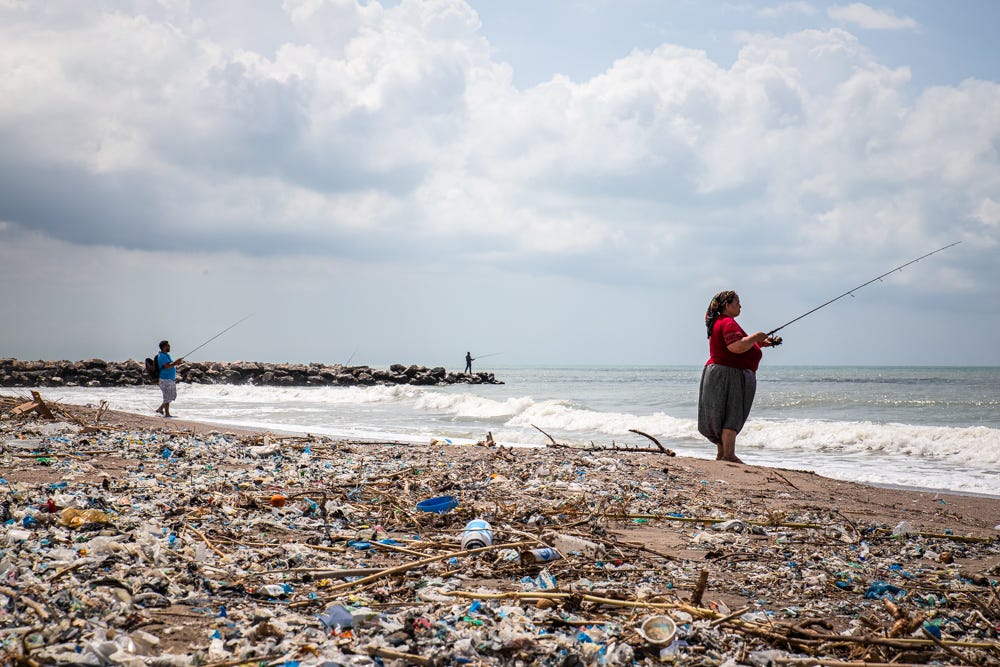
ADANA—The Çukurova Delta holds extraordinary natural beauty. Nestled between the Seyhan and Ceyhan rivers along Turkey’s Mediterranean coast, the region is home to swathes of lakes, swamps and lagoons, hosting dozens of migratory bird species, including flamingos and pelicans.
Its sandy beaches rank among the country’s most expansive. Every summer, the nation’s largest populations of loggerhead and green sea turtles come here to lay their eggs.
Yet, following a recent boom in foreign waste imports, this ecosystem is increasingly threatened by the unregulated dumping of plastics sent here to be recycled. Like rain, plastic refuse pours on the region, amassing in waterways that carry it out to sea, where it’s regurgitated back onto local beaches.
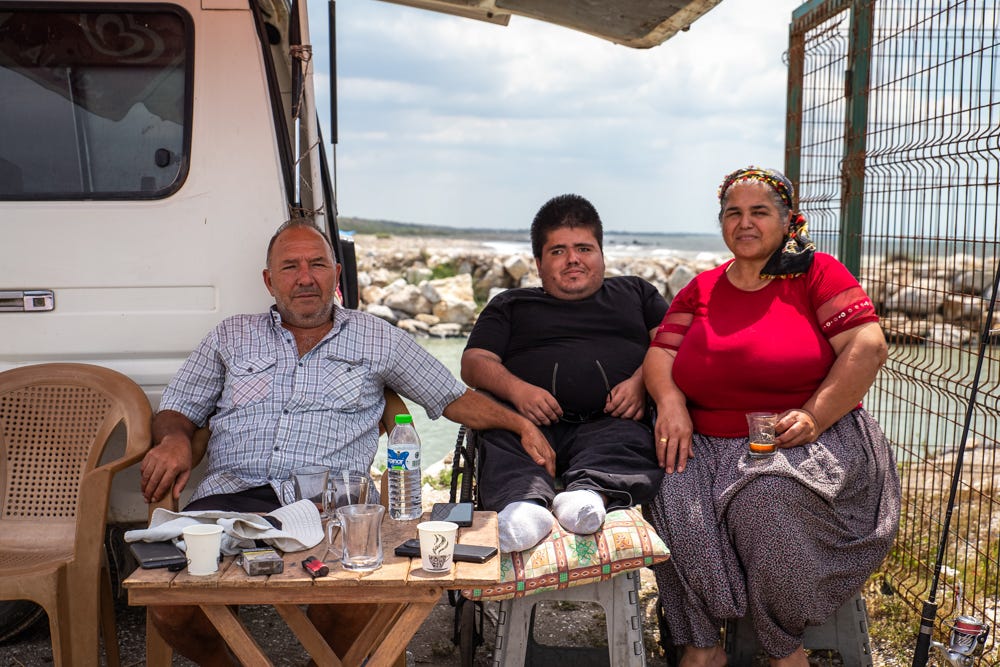
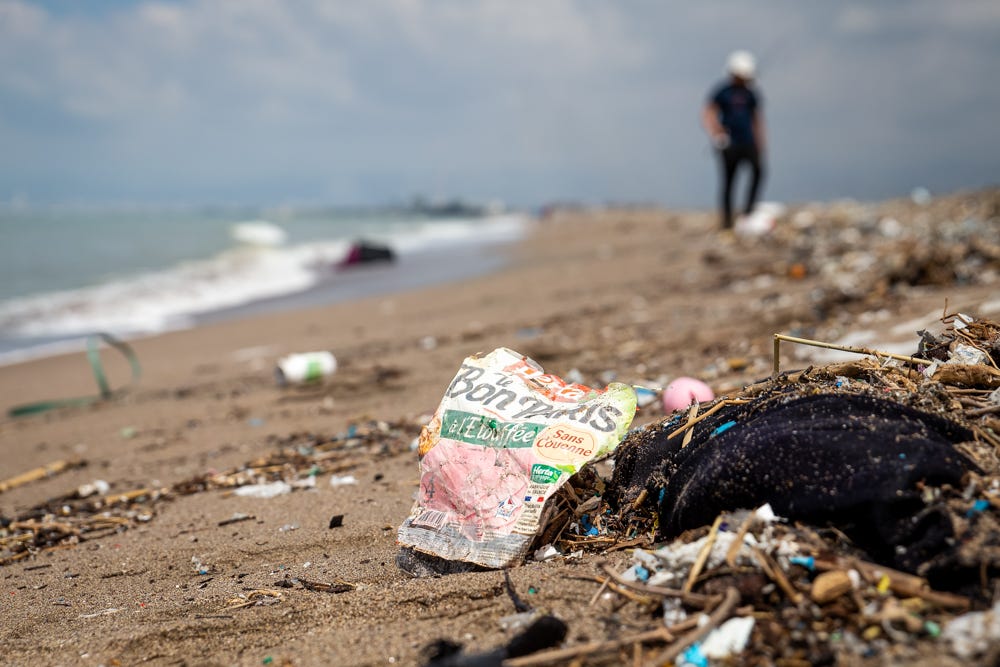
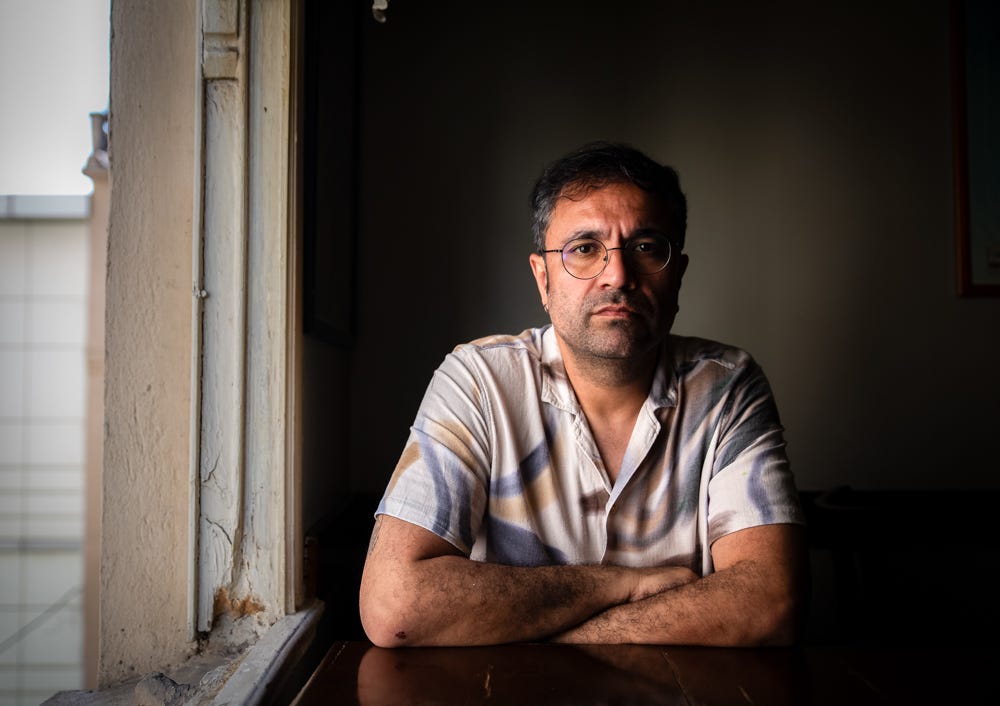
“It used to be all pure sand,” said Kenan Ülgen, a 60-year-old local retiree, sitting at the deserted Adanalıoğlu Beach. Colorful debris is visible all the way to a soda ash and chrome factory in the distance. Some waste bears European labels, but most has been broken down into tiny, unrecognizable fragments. A foul smell hangs in the air.
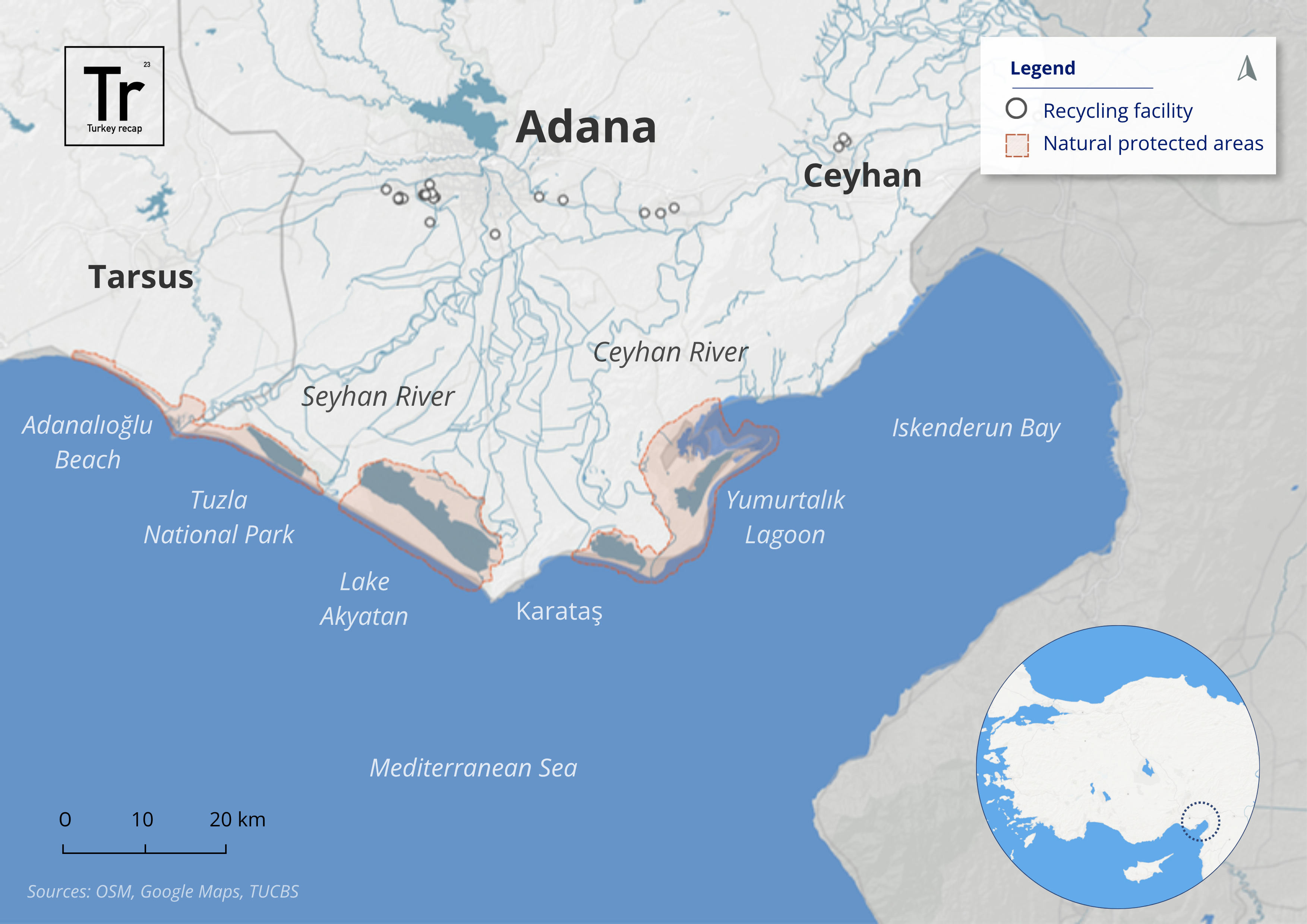
Not so long ago, Ülgen explained, these beaches were bustling with swimmers and families enjoying picnics. But “people started searching for places that are more, you know, clean,” he told Turkey recap. Now, the Seyhan River and its adjacent canals empty an estimated 5.3 billion microplastic particles into the Mediterranean Sea per hour.
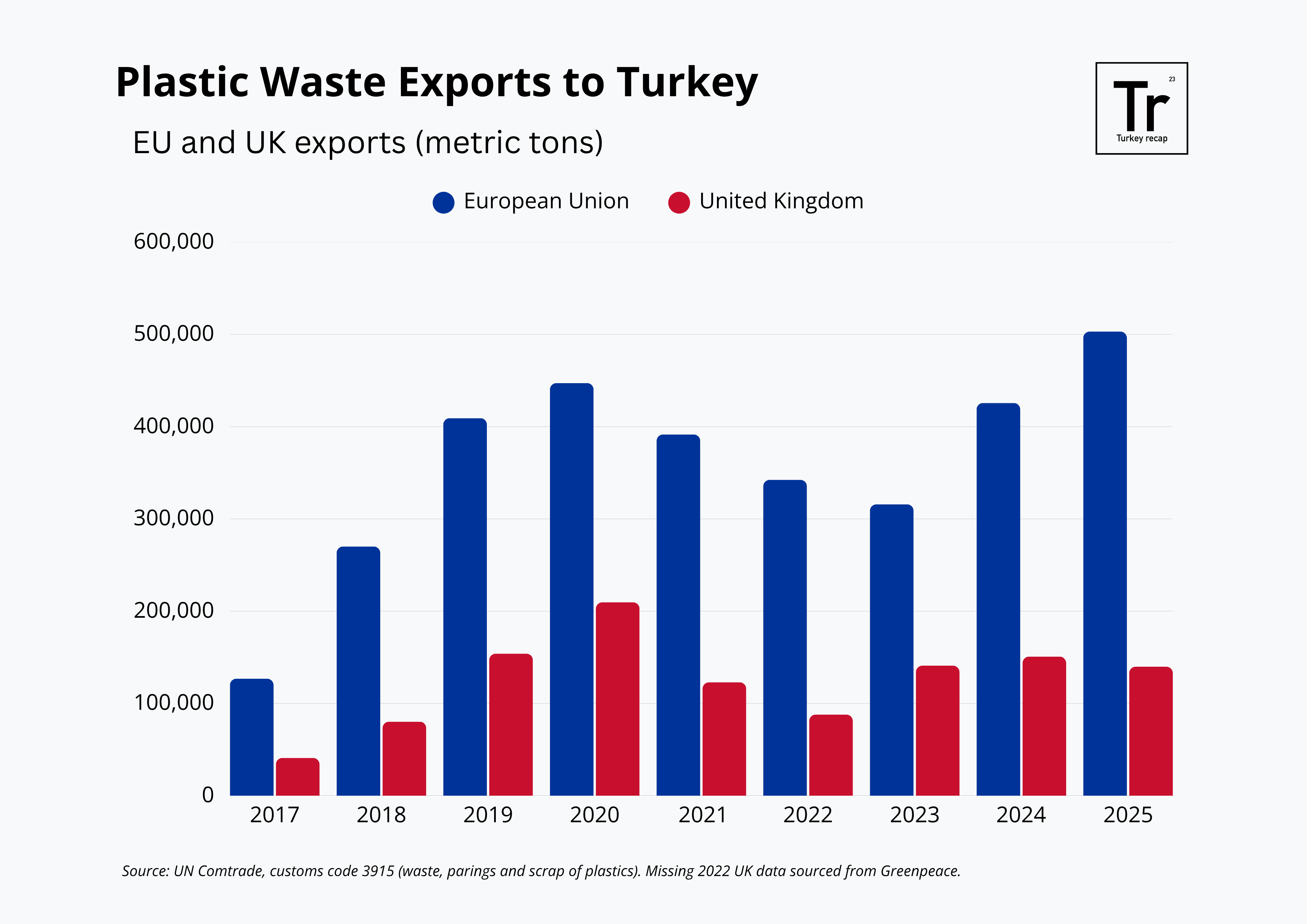
After China banned plastic garbage imports in 2018, Turkey became the leading destination for Europe’s plastic waste, pitching itself as a frontrunner in responsible waste management. In 2025, it collected a record high of 503,000 tons of the European Union’s plastic, and this figure is expected to grow with an upcoming revamp of the bloc’s waste regulations in November.
The majority of this lucrative foreign waste arrives at one of the nearly 200 recycling facilities in Adana. Inside these plants, the material is supposed to be sorted, shredded and processed, often into plastic granules for resale to industrial manufacturers.
But many activists, locals and scientists are skeptical of Turkey’s recent recycling push. They state that amid a lack of regulatory oversight and processing capacity, vast amounts of plastic trash are dumped, burned or discharged into the streams, wreaking havoc on the environment in Adana and beyond.
Pending EU regulation
Turkey’s waste disposal problems, experts and activists fear, are poised to accelerate when the EU’s revised Waste Shipment Regulation comes into effect in November 2026. The legislation will ban plastic waste exports to nations outside the Organisation for Economic Co-operation and Development (OECD).
The result for Turkey, as an OECD member state in close proximity to Europe, is that it will likely absorb even greater volumes of foreign trash and refuse.
The new rules will bring additional controls to address some concerns, including a requirement for nations like Turkey to explicitly approve all incoming shipments through a tightened “Prior Informed Consent” system.
European exporters must also fund independent, third-party audits to verify that foreign facilities meet strict EU-equivalent environmental standards. Additionally, the EU can completely suspend exports to any country failing to manage waste properly.
Such measures won’t be sufficient, according to Berk Butan, the social and economic systems campaign lead at Greenpeace Turkey.
“The global waste trade is inherently opaque and prone to systematic mislabeling,” Butan told Turkey recap. “The only sound solution is an unconditional, permanent ban on waste imports.”
Multiple experts told Turkey recap that recycling cannot be the primary solution to the current plastic crisis. Instead, they argue that high-consuming nations should reduce their plastic use and take responsibility for managing their waste “in-house.”
“By offloading this high level of waste onto other countries, including Turkey, it also displaces the opportunity for those countries in question to recycle their own domestically produced plastic waste in an environmentally sound manner,” said Lauren Weir, a senior campaigner at the Environmental Investigation Agency (EIA).
The office of Anna-Kaisa Itkonen, the European Commission spokesperson for climate and environmental policies, did not respond to requests for comment prior to the publication of this report.
Adana’s waste problem
The sheer volume of plastic waste dumped in Adana has flooded local waterways with high concentrations of microplastics and other toxins, said Sedat Gündoğdu, a marine biologist at Adana’s Çukurova University, who has been tracking pollution from the recycling industry for nearly a decade.
Gündoğdu said many of Adana’s recycling facilities routinely discharge untreated wastewater directly into local canals as they struggle to cope with immense amounts of both European and domestic trash.
According to Gündoğdu’s studies, water immediately downstream of these facilities has microplastic concentrations up to 132 times higher than upstream levels. Analysis of the wastewater shows it often contains consumer plastics, while the shapes of the particles suggest they likely come from industrial discharge rather than general litter.
“They are discharging this polluted wastewater into the canals, and farmers use that canal as an irrigation source,” Gündoğdu told Turkey recap. “Think about all the pollution transferred into the food system.”
His research found that agricultural soil irrigated with this water contains much higher levels of microplastics. This severely threatens the productivity of local farmland.
Over time, these toxic chemicals can also accumulate in edible parts of the produce and find their way into humans or wildlife. Microplastic intake has been associated with cancer, heart attacks, reproductive problems and a variety of other harms.
Much of the waste also ends up being burned either in Adana’s districts or inside recycling facilities, said Sabahat Aslan, head of the Mersin Environment and Nature Association. She added that the toxic smoke spreads into surrounding neighborhoods, where there are elevated rates of respiratory diseases and cancer.
“One of our friends living in this recycling neighborhood, she currently has cancer,” Aslan told Turkey recap. “It happened after the facilities [opened].”
About 200 fires at plastic recycling facilities have been reported in Turkey over the past five years, with 15-20 of them occurring in Adana. Local environmental organizations claim that such frequency alludes to a systemic pattern—possibly of waste disposal—rather than isolated incidents.
The plastic’s impact is also visible at sea. The Seyhan and Ceyhan rivers now account for nearly a tenth of the total plastic waste entering the Mediterranean Sea. This pollution, together with sea currents carrying debris from nearby countries, has taken a severe toll on local fish stocks, said Celal Safsoylu, head of the Karataş Fisheries Cooperative in Adana.
“Many species are facing extinction,” Safsoylu told Turkey recap. He explained that much of the trash accumulates on the seabed, ravaging bottom-dwelling fish. “It greatly affects fish like sand smelt, red pandora and sole,” he said.
To combat the growing waves of waste and the resulting loss of income, a municipality-backed program was recently launched to pay fishers for the plastic waste caught in their nets, Safsoylu said.
Root causes
Gündoğdu believes the illicit disposal of plastic waste is deliberate. Many of Turkey’s recycling facilities are overwhelmed following the influx of more lucrative European waste, and more environmentally sound recycling practices are expensive. Stricter procedures would erode waste importers’ profits, he noted.
“They [recyclers] stopped taking waste from domestic sources because of the profit margins,” Gündoğdu said.
He added that European firms, including those in the UK, cover all transport and tariff expenses since these exports are subsidized through a recycling designation. These firms also pay in foreign currency, and Europe’s trash is considered cleaner and easier to process, said Amy Youngman, a legal policy specialist at the EIA.
Recent figures indicate that Turkey imports more plastic waste than it can process. According to data from the Ministry of Environment, Urbanization and Climate Change, there are currently about 1,263 facilities capable of processing plastic waste in Turkey, with a total recycling volume of approximately 1.125 million tons.
The same figures show Turkey’s total annual plastic waste imports amount to about 1.3 million tons, on top of the 3.3 million tons generated domestically.
The government has taken steps to address its waste burden, most prominently through its Zero Waste program, launched in 2017 and led by First Lady Emine Erdoğan. Since the initiative’s introduction, officials claim that waste recovery rates have almost tripled to 37.5 percent.
Illicit plastic trade
Besides rising inflows, Turkey has also struggled to curb the illicit trade in plastic waste.
“[The Turkish government] is kind of sacrificing certain communities in the Adana region in order to promote themselves as having this ability to receive all this waste,” Youngman told Turkey recap.
Customs controls tend to be severely under-resourced, inspecting just a fraction of shipments, while exporters frequently disguise ordinary, unrecyclable trash to bypass regulations.
“We see frontloading of clean plastic waste, and behind it is mixed household waste,” Youngman said. “So there is criminal intent mixed within it.” Unless a container happens to be opened or “smells like dirty diapers,” she said, tons of unrecyclable waste from Europe slip through the cracks every year.
Last month, a UK company was prosecuted for trying to illegally export three shipments of plastics contaminated with household waste—including sanitary products, diapers and trash seemingly originating from France—to Turkey. In the official paperwork, the company claimed the shipments contained clean plastics, also known as “Green List” waste.
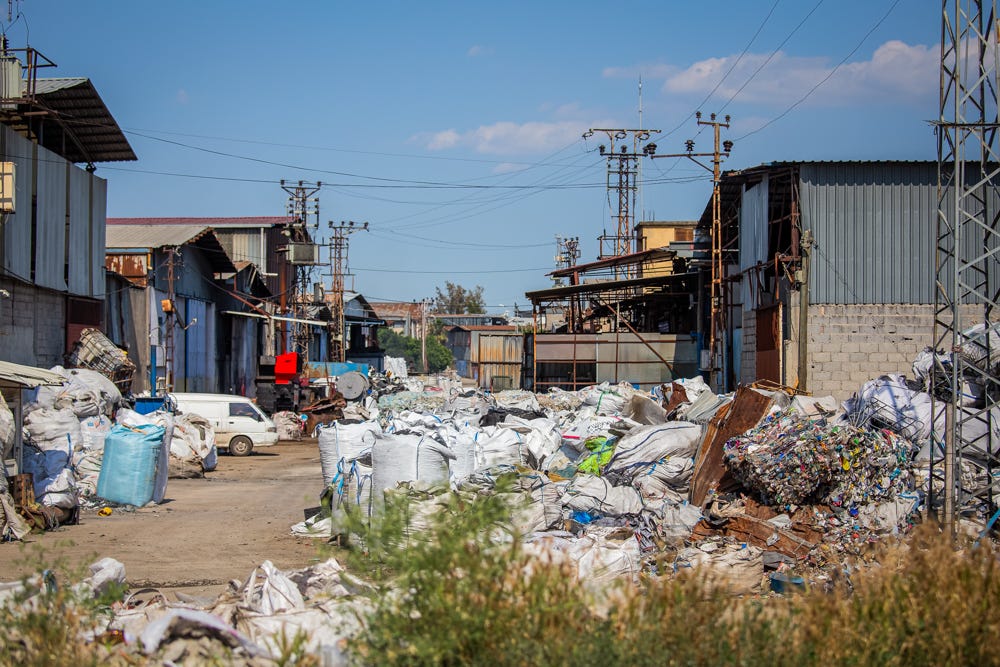
In May, Turkey recap visited several dumping sites near Adana’s recycling district and observed various types of contaminated plastic waste, some of which was burned or seemingly dumped into the waterways. It was unclear whether this waste came from local facilities or contained foreign refuse.
According to a 2025 statement by Turkey’s Directorate of Communications, imported waste is meticulously monitored from customs to the facility. It also said that between January 2021 and February 2025, nearly 30,000 inspections of waste disposal and recycling facilities were conducted, resulting in the suspension of 227 facilities and fines totaling 913 million TL.
Rising plastic prices
As Turkey spotlights its environmental policies ahead of November’s COP31 summit in Antalya, shipping and supply constraints stemming from the Iran war are changing the cost structures of plastic waste management.
Most prominently, the prices of virgin plastic have skyrocketed this year. The closure of the Hormuz Strait has sent shockwaves through the production, sale and transport of plastics, which are all made from oil and gas. This has sparked speculation that recycled plastic or other materials could benefit from more favorable economic conditions.
“Europe is starting to shift its perspective. Due to costs, plastics that were once viewed as waste are now considered a raw material,” said Ali Mendillioğlu, the head of Turkey’s Recycling Workers Union.
Gündoğdu is less convinced. He argues only about 9 percent of all plastic waste worldwide has ever been recycled, and this is often downcycled into weaker, lower-quality materials that have limited utility.
“They [Europe] claim they are feeding Turkey’s own circular recycling industry. But plastic recycling isn’t actually circular. It’s a toxic business. When you recycle plastic, you produce material that is even more toxic than the original,” Gündoğdu said.
Turkey recap is an independent, reader-supported newsletter that helps people make sense of the fast-paced Turkey news cycle. Get in touch at info@turkeyrecap.com.
Subscribe here on Substack (or on Patreon for discount options). Paid subscribers get full access to our recaps, reports, members-only chat and news tracking tools.
We are an affiliate of the Global Forum for Media Development and aim to produce balanced news that strengthens local media by supporting journalists in Turkey.
✅ Typos verify our humanity. All Turkey recap news output is created and fact-checked by people. Find our AI policy in our Code of Ethics.
Diego Cupolo, Editor-in-chief
Emily Rice Johnson, Deputy editor
Yıldız Yazıcıoğlu, Parliament correspondent
Hilmi Hacaloğlu, Political correspondent
Gözde Ocak, Stüdyo recap editor
Demet Şöhret, Social media and content manager
This article is part of a series of reports focusing on Turkey’s climate governance produced with support from the Heinrich Böll Stiftung Turkey Office, and in no way reflects the views of the Heinrich Böll Stiftung.