


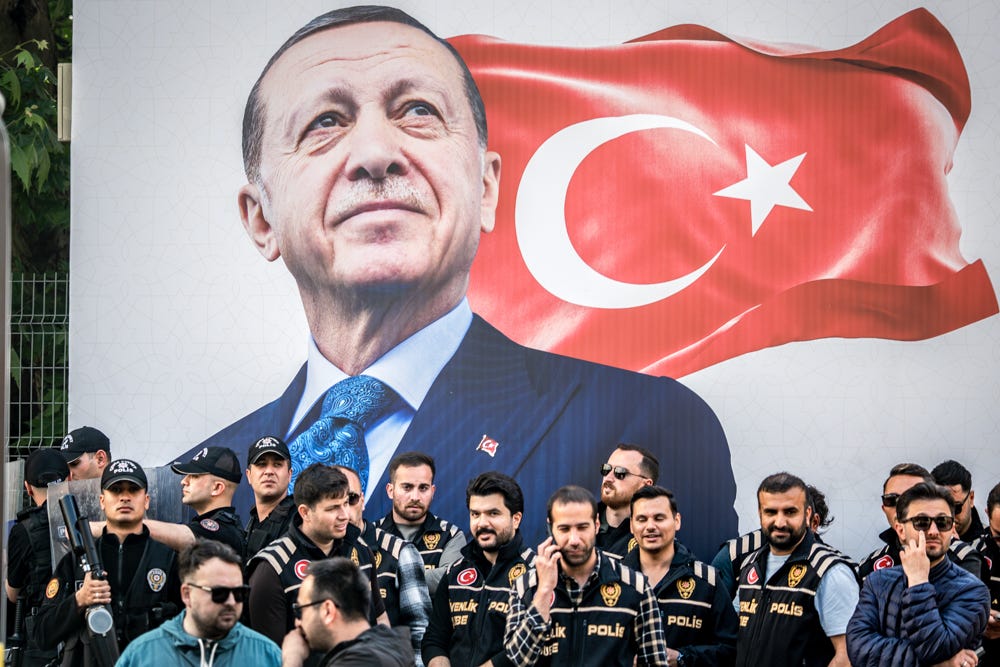
ISTANBUL—Sunday was a dark day in Turkish democracy. Police in Ankara used force to enter and clear out the headquarters of the main opposition Republican People’s Party (CHP). A court dismissed its leadership Thursday and reinstated the party’s deeply unpopular previous leader, Kemal Kılıçdaroğlu. Heavy clashes ensued.
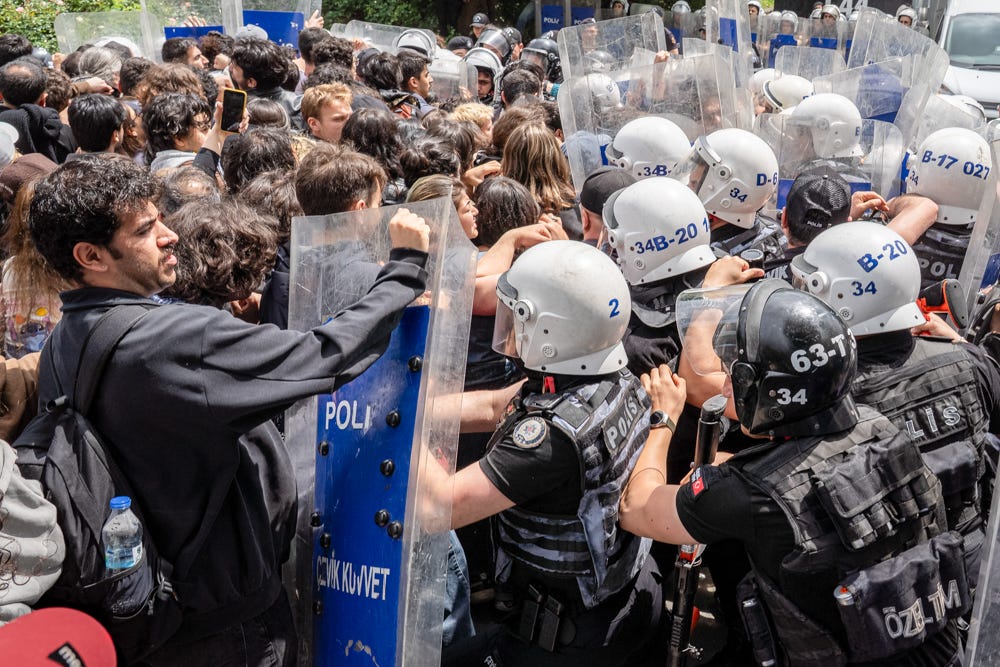
But the CHP’s headquarters was not the only institution the state violently took over that day. In Istanbul, riot police marched into Bilgi University and pushed out all remaining students. By the campus gates, hundreds of students and academics clashed with police armed with riot shields and pepper spray.
The events were sparked by a presidential decree, published at midnight three days prior, ordering the immediate closure of Bilgi University — one of the most prestigious private universities in Turkey. The decree was two lines long, offering no explanation for the decision.
In one night, over 20,000 students and all of the university’s staff were left out to dry, not knowing if they were still students or had a job. Then, in the early hours of Monday, Pres. Recep Tayyip Erdoğan reopened Bilgi with the ease of reopening a faucet. Again, the few meagre lines of the presidential decree offered no reasoning.
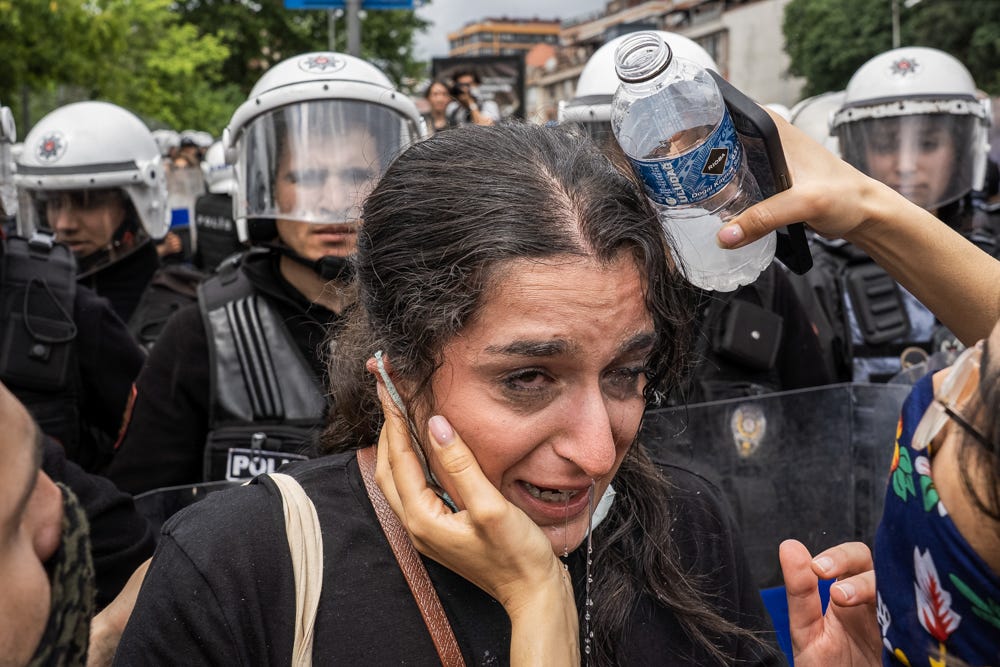
“There is a Turkish expression that goes ‘when the knife reaches bone’, meaning when push comes to shove,” Poyraz, a student at the protest, told Turkey recap. He was still blinking from the pepper spray. “Right now, the knife has reached the bone. In fact, our whole arm is being cut off. That’s why I see two options for Turkey. We either come to our senses and revolt, or we die.”
Revolt the students did, and for once, successfully it seems. While CHP’s headquarters remain occupied by security forces and the party’s previous elite, students last night reentered their campus to celebrate. There were no expressions of gratitude to the president — “we won” was the message.
Violent clashes
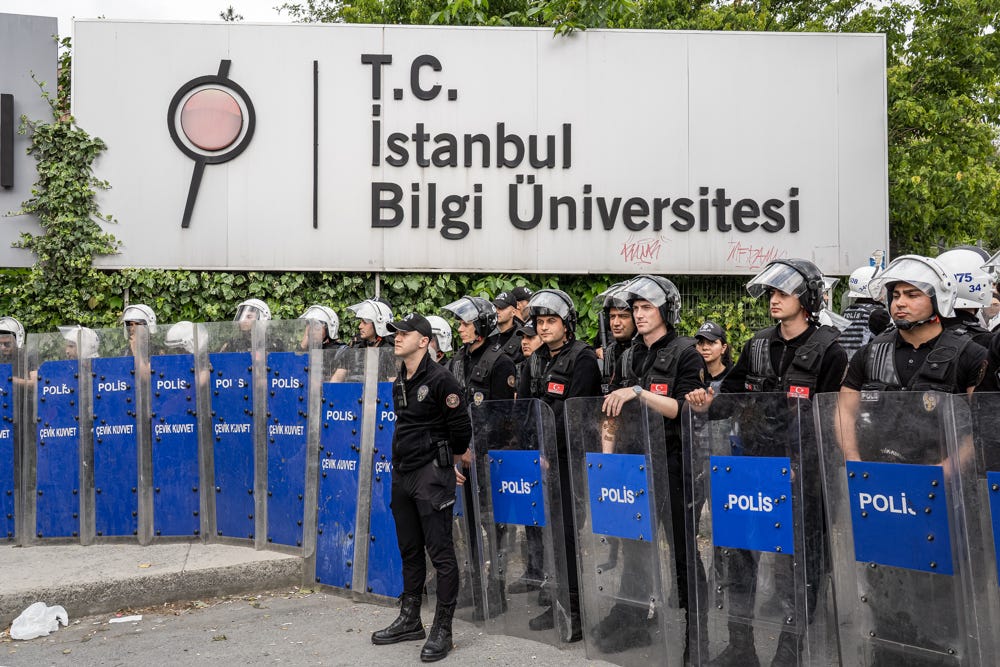
The day after the presidential decree was issued, thousands of students and protestors gathered on campus. There was anger in the air, but even more dominant was confusion. The next day, only registered students were allowed to enter. On the third day, no one could enter and the police surrounded the campus. The remaining few dozen students inside were violently dragged out.
Outside, hundreds of students gathered to protect their university. Police barricades, hundreds of officers, and an armored vehicle with a water cannon (referred to as TOMA) blocked their entrance. “What business does a TOMA have in a university!” the students chanted and threatened to break through the barricades. The officers behind the shield wall only smirked.
The students then attempted to push through. Officers responded with pepper spray and a vicious counter charge, hitting anyone they could with their shields.
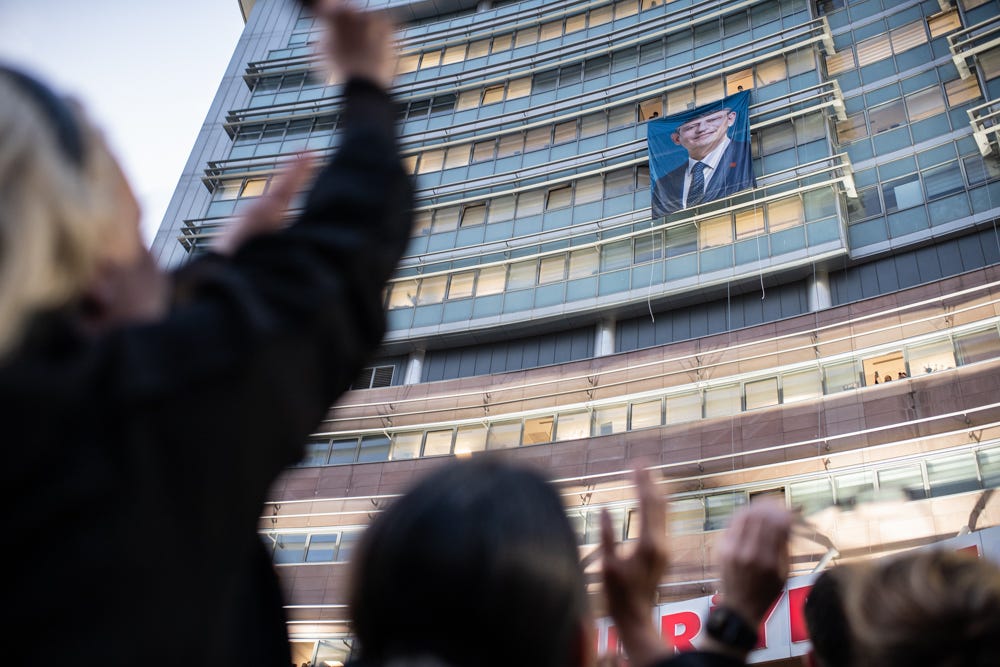
Almost exactly parallel to the clashes at Bilgi University, police in Ankara broke down the gates of CHP’s headquarters and cleared the building out with tear gas and rubber bullets. Water cannons were used to disperse the crowd outside. Having lost their party building, CHP chair Özgür Özel decided to march on the parliament.
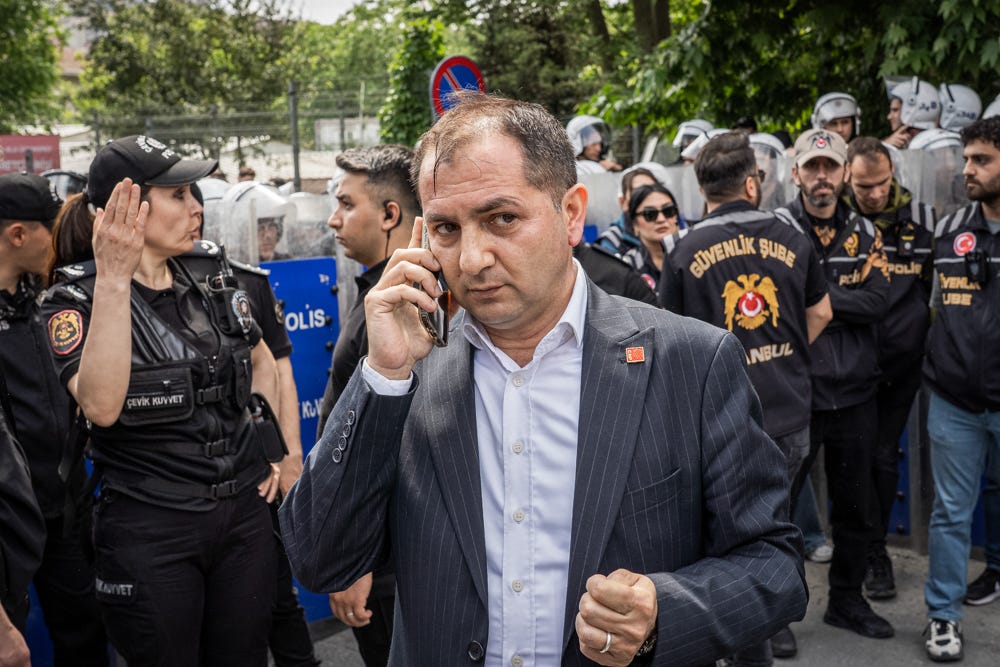
Back at Bilgi, Doğan Sarıtaş, the head of the CHP’s local district branch, was trying to mediate between the police and the protestors. Following the clash, he stood on the side, his face red from the pepper spray. He stared at his phone, viewing videos of his party headquarters being filled with teargas, and an army of officers.
“The country is on fire,” Sarıtaş snapped. “Injustice and lawlessness are spreading everywhere. On the one hand, there are the events at our headquarters, and now we are at a university. They are preventing our students from entering their own school. We stand with the students, with our friends. We will support their struggle to the very end.”
“Of course, we are hopeful,” he said, despite looking distraught. “More than that, we have strong faith. It’s not just hope. We truly believe we will win this fight. For this country to finally achieve peace, justice, prosperity, and a fair and equal life, we will carry on our struggle on the road to the government. And I believe the election will come very soon — and we will win.”
The closure of the university and the students’ protest would normally be front-page news for Turkey’s independent media. However, it received little coverage over the weekend. All eyes and lenses were turned to the events in Ankara.
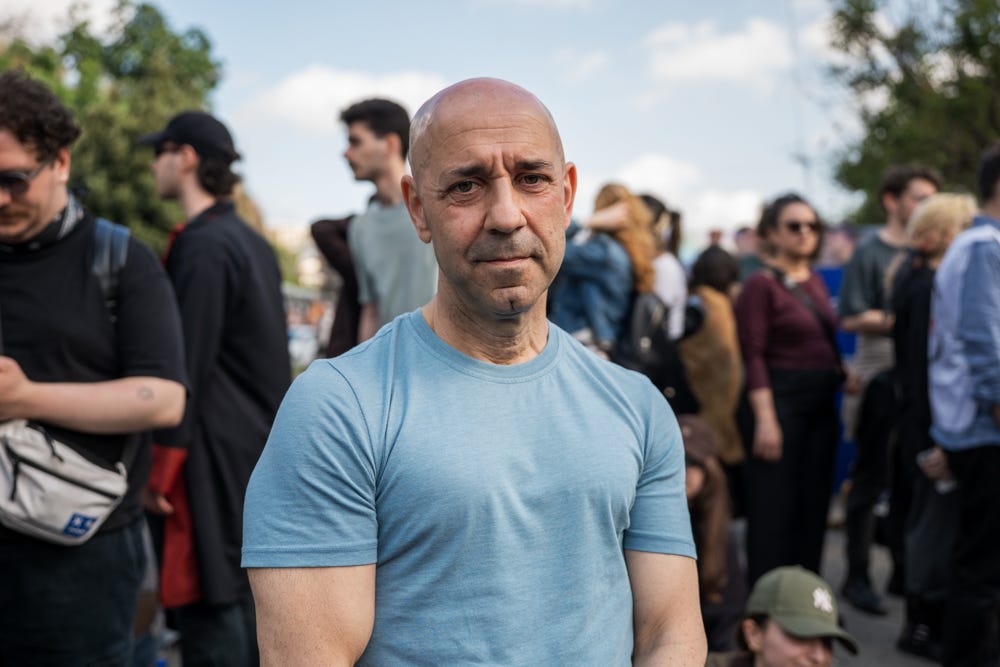
“Yes, this received little attention,” conceded Abdullah, a student at Bilgi. “But at the same time, we also need to say this: what is happening in Ankara and here at Bilgi are not independent from one another.”
“It’s not just about a trustee being appointed to a political party,” Abdullah continued. “The fact that decisions can be made this way — that’s what has actually brought us to this point. Even if right now we don’t know the exact reason behind this closure decision, it stems from the same politics.”
Murky reasons behind the closure
The exact reason for Bilgi University’s closure and reopening remain unknown. At the time of publishing, no official reasons were given by state representatives. None of the students, professors, and teachers’ union representatives interviewed by Turkey recap could provide a clear explanation either.
The main lead behind the decision is the university’s links to Can Holding, a major Turkish conglomerate operating in energy, education, media, logistics, and retail. In 2019, Can Holding purchased Bilgi University for around 90 million USD. Then in 2025, the conglomerate came into direct conflict with the state.
Following a report by the Financial Crimes Investigation Board (MASAK), the authorities accused the conglomerate’s top leadership, including owners Kemal Can and Mehmet Şakir Can, of running a criminal organization. They were charged with tax evasion, money laundering, and smuggling.
The assets of the conglomerate were seized, and a local court replaced Bilgi University’s board with state trustees, or kayyum — the most notorious term in Turkish politics of the past few years.
In other words, the state already exercised control over the university through its trustees. Thus, it is unclear why Erdoğan felt a need to revoke the university’s liscence, or indeed, why he restored it.
Both the closure of Bilgi University and the dismissal of CHP’s leadership were strategically timed. They happened one day before the nine-day-long holiday for the Feast of Sacrifice (Kurban Bayramı) began. During these days, financial markets remain closed, and vast segments of the population desert the major cities to go to the countryside.
Yet, despite the initial days of relative inaction and confusion, tens of thousands across Turkey marched in the streets against the government’s actions on Sunday. The students at Bilgi might have received little attention, but regained something much greater: their university.
In the meantime, CHP chair Özgür Özel vowed to take the fight to the streets. “CHP from now on is on the roads, in the streets, in the squares,” Özel shouted Sunday in his coarse voice.
Turkey recap is an independent, reader-supported newsletter that helps people make sense of the fast-paced Turkey news cycle. Contact us: info@turkeyrecap.com.
Subscribe here on Substack (or on Patreon for discount options). Paid subscribers get full access to our recaps, reports, members-only chat and news tracking tools.
We are an affiliate of the Global Forum for Media Development and aim to produce balanced news that strengthens local media by supporting journalists in Turkey.
Diego Cupolo, Editor-in-chief
Emily Rice Johnson, Deputy editor
Ceren Bayar, Parliament correspondent
Yıldız Yazıcıoğlu, Parliament correspondent
Günsu Durak, Stüdyo recap editor
Demet Şöhret, Social media and content manager