


Dear reader: Turkish parliament is taking a break, and so is Turkey recap. We’ll be pausing our recaps for the next two weeks (unless big news breaks, of course).
In the meantime, please stay away from Turkish Reddit and stay tuned for surprises in your inbox. We have many projects in the works. Thank you again for your continued support, which makes all of this possible.
In this week’s recap:
A risk and opportunity, parliament adopts framework law
What’s next and constitutional debates
How the Turkey-Pakistan-Saudi pact took shape
Domestic and diplomatic wraps
Sivas shows off its köpeks in Kangal beauty contest
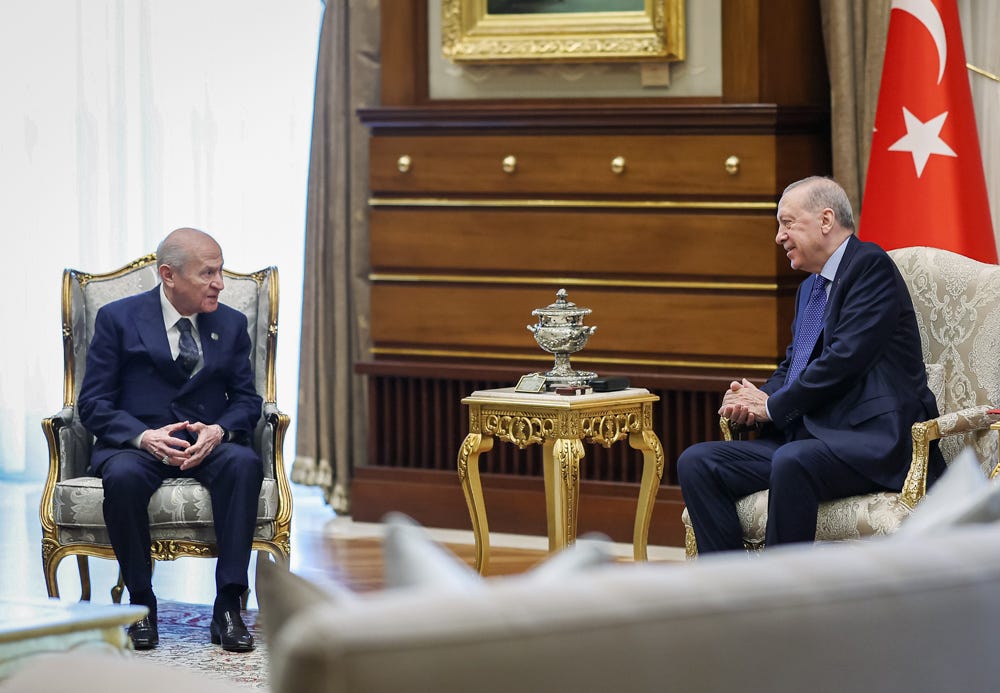
The negotiations ended like they began—with a Devlet Bahçeli handshake. It took nearly two years to pass the “framework law,” and after Pres. Erdoğan signs it the actual peace process will start, which is the hard part.
To recap, Turkish parliament adopted a law Monday establishing the legal framework for the disarmament and repatriation of some PKK militants, functioning in practice as a conditional amnesty (see last week’s issue for details).
The measure represents both opportunities and risks for advancing the Turkey-PKK peace process in what supporters call a “new beginning” for Turkish democracy—a notion that would have more buy-in from opponents if the same government was not actively jailing a growing number of democratically-elected officials.
Disclosure for new readers: My wife is an MP with the pro-Kurdish DEM Party.
What happened: The Parliament’s Justice Commission greenlit the framework law proposal without changes after 17.5 hours of debates and one scuffle Saturday morning.
The draft bill then went to the General Assembly Monday, where it was rushed through that evening to avoid televised parliamentary debates in the following days, parliamentary staff told Turkey recap.
A total of 467 out of 591 MPs voted to adopt the law, which drew a split vote from Yeni Party members, signaling parliamentary alignments might be ripe for passing constitutional amendments (covered below).
Reactions were as diverse as Turkey’s demographics, though cautious optimism and lingering doubts sum up the national mood—which tends to be darker online than on the ground.
In their vote justifications, most Turkish political parties viewed the dissolution of the PKK as net positive for the country. At the same time, the heavy judicial pressure on government opponents, the conditional amnesty and the opacity of negotiations anchor most criticisms of the peace process to date.
Senior militants had their own complaints about the law’s exclusion of PKK leader Abdullah Öcalan, though reporting from Kurdish-majority areas suggests locals expect improved economic conditions from a long-term ceasefire.
The state recently estimated the four-decade cost of the Turkey-PKK conflict to be $2.3 trillion. While the peace process remains highly delicate and prone to interference, initial reactions among non-secular voters interviewed by Turkey recap were positive.
“I will definitely vote for the AKP in the next elections,” said a Kurdish voter from Malatya who withheld his name. “They are addressing issues that have a direct impact on my life. What have the Kemalists done for me?”
Analysis: In a phone interview this morning, Osman Can, a law professor at Marmara University, former AKP official and former rapporteur-judge for Turkey’s Constitutional Court, said the framework law is not designed to solve Turkey’s Kurdish question, but it’s part of an attempt to do so.
“This is a technical procedure” for demobilization and reintegration framework, Can told Turkey recap. “The expectation is huge … and the reality is messy, but this is an important step. Something has to be done, and this is the minimum starting point.”
Can said that addressing the Kurdish issue requires engaging with the root causes in Turkey’s history of forced assimilation and repression of minority rights, both of which are “missing” from this narrow legislation focused on disarming militants.
Critics of the law have pointed out this gap, as well. They add the basis for its long-term sustainability, as outlined in the text, is vaguely defined and largely dependent on assessments by its implementors—or state officials who can pull the plug any moment and who are legally shielded from prosecution if the peace process falls apart. This is by design, according to Can.
“The constitution doesn’t recognize Kurds,” he said, explaining that an attempt to address the Kurdish issue can be unconstitutional in itself. “That’s why it is understandable that the government wants more [legal] space for that.”
The “dilemma”, he said, is the same government has been rolling back “democratic standards and rule of law over the last 15 years in Turkey,” and lacks public trust.
“Yes, the law is vague,” Can continued. “But based on our current policymakers and our current reality … I think this moment is a risk for Turkish society, and also an opportunity.”
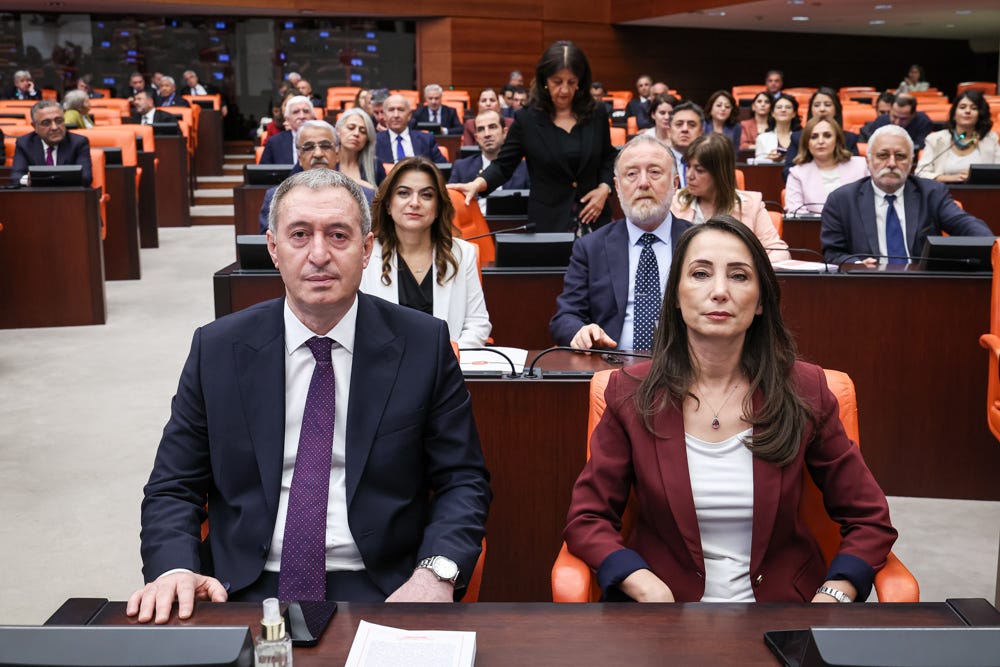
Fallout oy: What’s next and constitutional debates
