


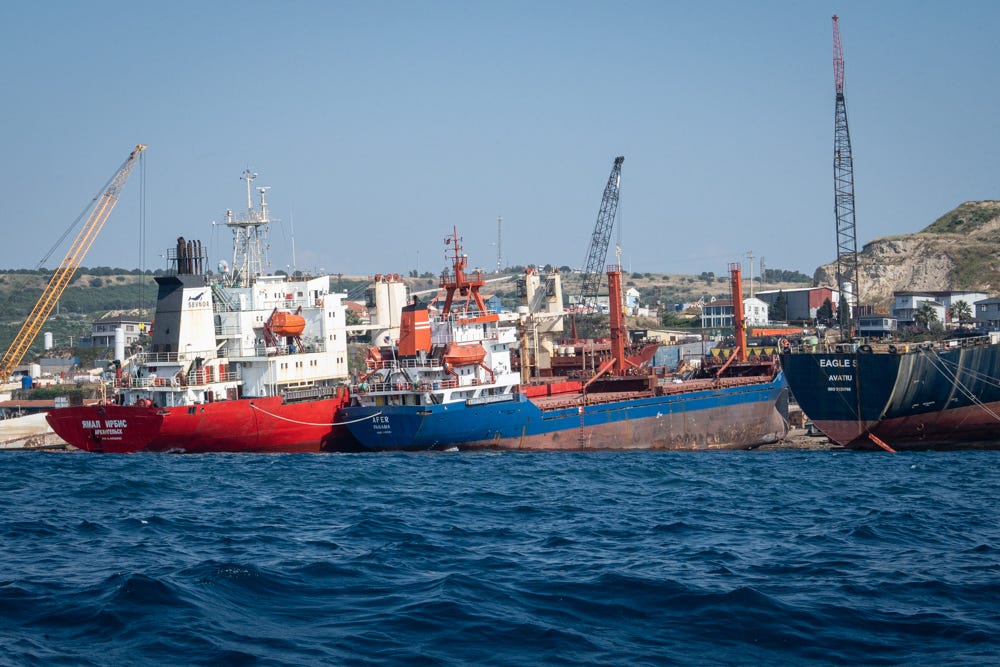
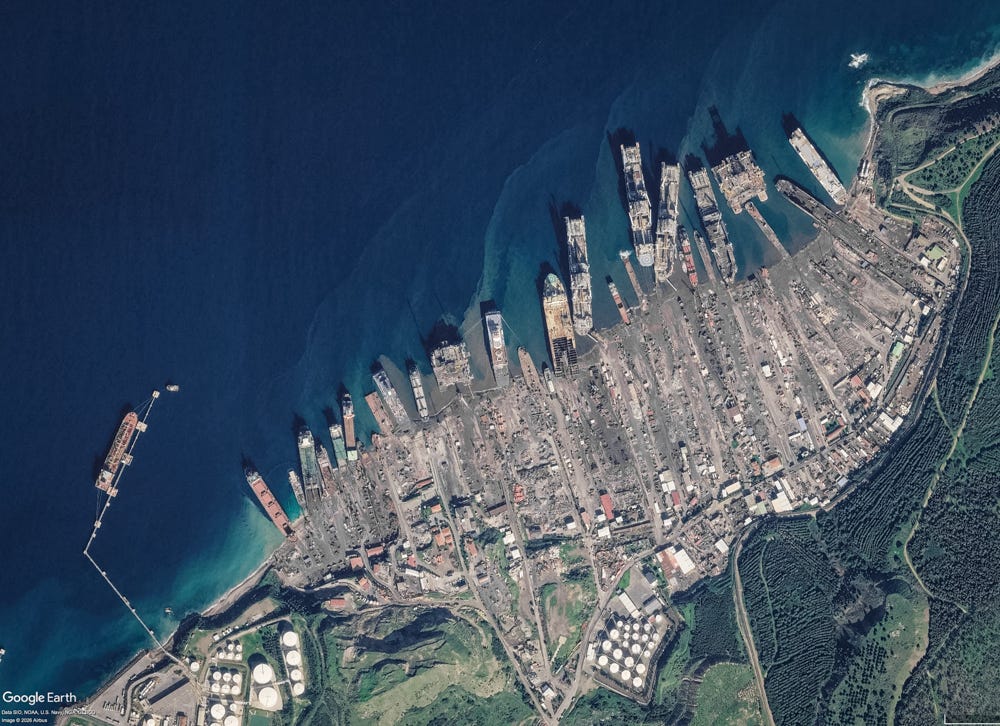
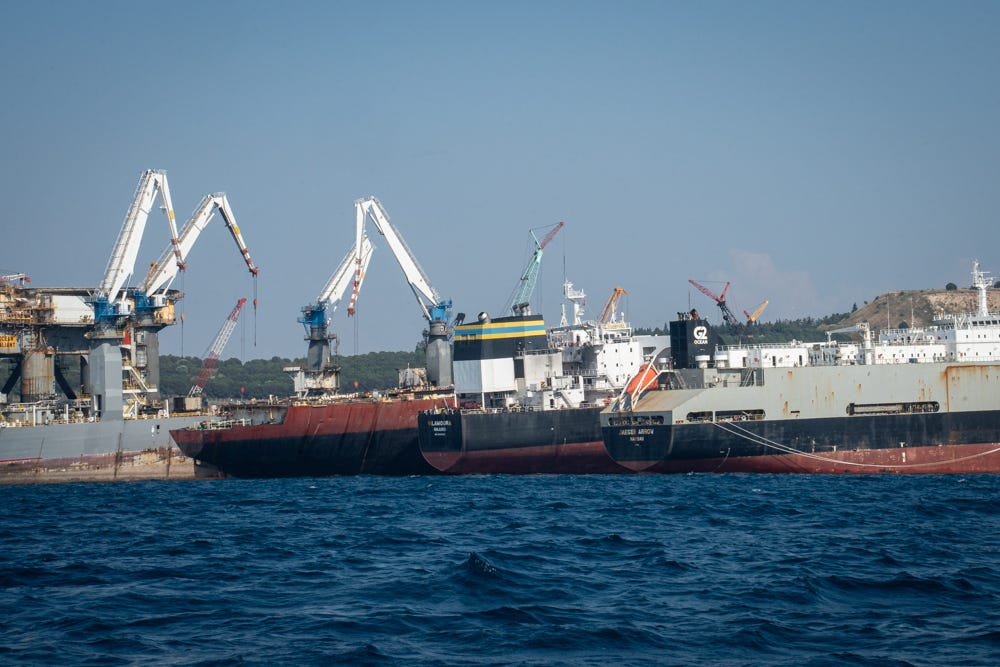
ALIAĞA—Hidden at the edge of the Aliağa peninsula, an industrial town on Turkey’s western Aegean shore, lies the world’s third-largest ship-breaking hub.
Every day, across just over a kilometer of coastline, about 1,500 workers use cranes, blowtorches and their hands to strip down massive hulls into manageable pieces for nearby steel mills and processing facilities.
Long a graveyard for both old ships and the men who dismantle them, Aliağa’s scrapyards have more recently become a final stop for Russia’s notorious shadow fleet.
This armada of worn-out tankers operates outside the international maritime system, allowing Moscow to export oil and evade Western sanctions imposed after its 2022 full-scale invasion of Ukraine.
Yet, as more shadow fleet vessels age out of service, a growing number are being sent to Turkish shores, where their unregulated status presents both legal and environmental challenges.
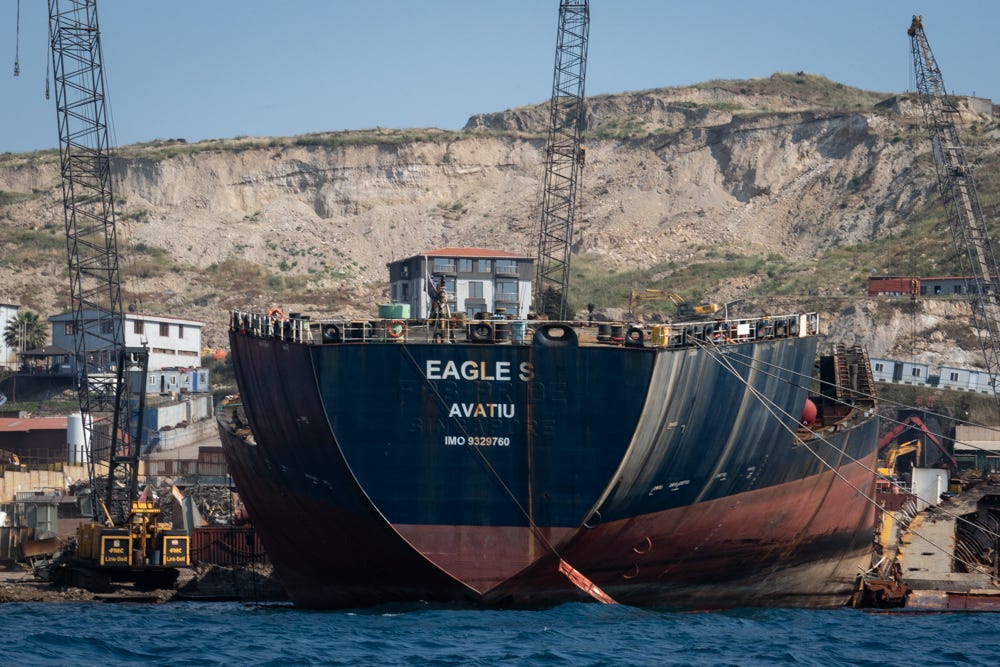
The Eagle S
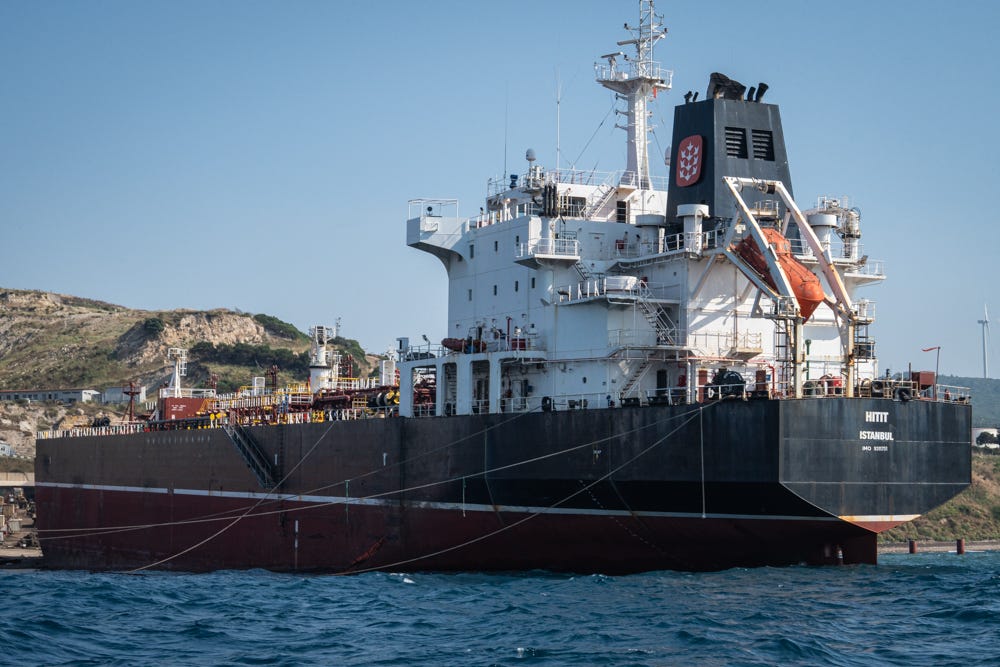
At least two sanctioned tankers, the Eagle S and the Hitit, were rammed onto Aliağa’s shores for demolition in recent months. Both have been sanctioned by the EU, Britain, Switzerland and Canada for their role in transporting nearly 3.5 million barrels of Russian black market oil since 2024.
The 229-meter-long Eagle S has also been linked to sabotage and espionage activities. In December 2024, the ship dragged its anchor across the Gulf of Finland, severing multiple Finnish and Estonian submarine cables.
This prompted a nighttime helicopter raid by Finnish special forces, who reportedly found surveillance equipment with Russian and Turkish keyboards onboard. Charges against the crew were eventually dropped as the incident occurred outside Finland’s jurisdiction.
A spokesperson for the Finnish authority that detained and inspected the ship told Turkey recap that there was no indication the vessel was destined for scrap at the time of its release last year.
Yet, social media footage showed the Eagle S arriving in Aliağa in November 2025 after disabling its tracking device off the Egyptian coast, according to Kpler data Turkey recap obtained from the Kyiv School of Economics’ (KSE) Sanctions Hub of Excellence.
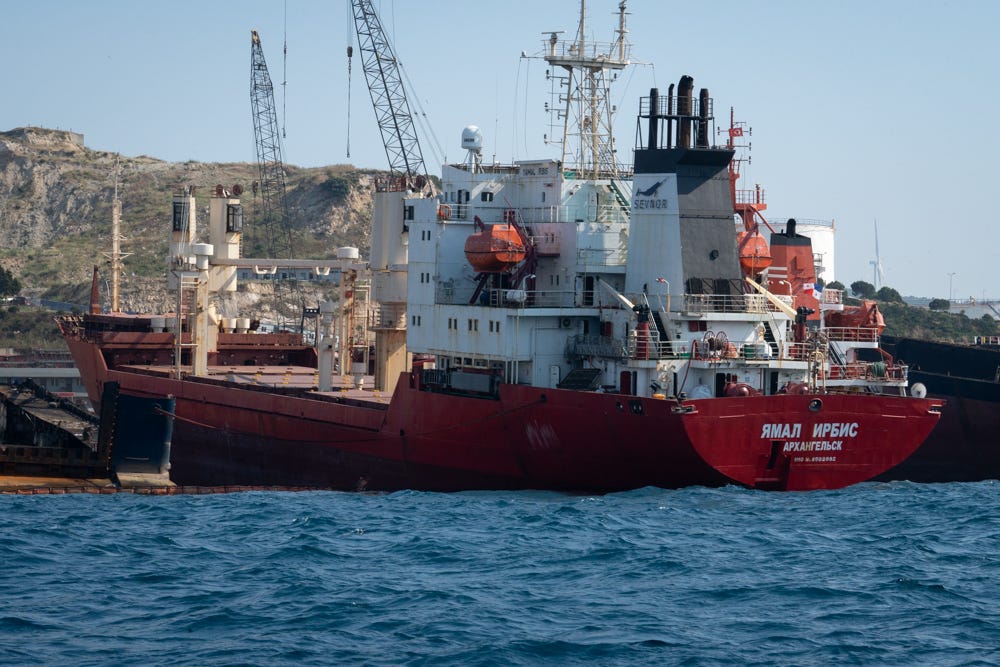
Today, the Eagle S lies side by side with various Russia-linked hulls in Aliağa. This includes the Turkish-flagged Hitit, a relatively well-kept tanker that lost its commercial value once sanctions were imposed on it in 2025.
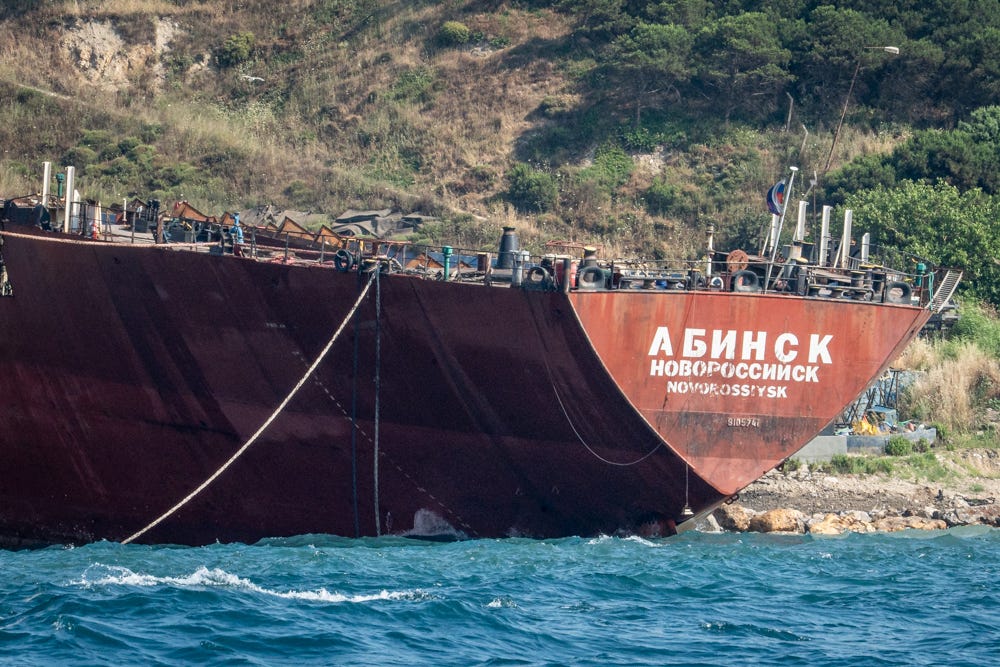
Also present are the Vilamoura, a tanker tied to Russian oil shipments that was damaged by a suspected Ukrainian attack off the Libyan coast in 2025; the Abinsk, a bulk carrier implicated in carrying grain from occupied Ukraine to Israel; and the Yamal Irbis, a cargo ship managed by a Norway-linked firm connected to US-blacklisted Russian energy companies.
Shell companies
Nicola Mulinaris, policy adviser at the NGO Shipbreaking Platform, said shadow fleet vessels are typically poorly maintained and riddled with unknown hazards such as oil residues and contaminated storage spaces.
“Scrapping dark or gray fleet vessels is more dangerous because these ships often come with compounded risks,” Mulinaris told Turkey recap.
Shadow fleet ships tend to be registered to shell companies to obscure ownership, making it difficult to determine who is responsible for cleaning and preparing them for recycling, as well as who profits from the sale of the sanctioned asset.
The registered shipowners of both the Eagle S and the Abinsk share the same address at the Meydan Hotel in Dubai, alongside approximately 60 shell companies known to facilitate shadow fleet shipments.
This includes firms tied to Aleksejs Halavins, a sanctioned Latvian figure central to the Russian oil trade. Halavins also managed a firm sharing a Cyprus address with suspected shell companies of the TMS Group, which formerly operated the damaged Vilamoura ship.
“The use of the Meydan Hotel in Dubai is common because it is a free zone where all of these single-ship companies can register,” Michelle Wiese Bockmann, a senior maritime intelligence analyst at Windward, told Turkey recap.
“The way that these purchases and scrapping are put together—it’s all done so people like you and me can’t find out who’s behind it,” she added.
Scrapping in the dark
Many shadow fleet vessels lack a valid flag or class status, which are needed to validate crucial documentation for safe dismantling procedures.
This includes the Inventory of Hazardous Materials (IHM), which details the exact locations of all toxic substances on board. Without it, ship-breaking yards cannot map out a sound recycling strategy.
Sanctions on the ships could also make them radioactive for the legitimate entities involved in their scrapping, explained John Alonso, who leads the technical cooperation on ship recycling at the International Maritime Organization (IMO).
“They will have no insurance, no IHM, and no auditors will dare to go there because, of course, they may be impacted if they receive any money,” Alonso told Turkey recap.
Alonso appeared surprised to hear Turkish yards had accepted sanctioned ships.
“I assume that whoever bought that ship and then recycled that ship is protected because if you are highly [flagged for violations] at some stage, all bank accounts of that company will be frozen. They will be absolutely unable to operate even with national banks,” Alonso said.
Turkey’s ship-dismantling yards are known to have strong ties to the government. The son of former Prime Minister Binali Yıldırım allegedly owns one of the facilities.
“Whenever we raise a problem regarding ship-breaking, they immediately say, ‘No, there is no such thing,’” Ibrahim Doğangül, an Aliağa municipal council member with the opposition Republican People’s Party (CHP), told Turkey recap.
Doğangül noted Aliağa Mayor Serkan Acar, of the government-allied Nationalist Movement Party (MHP), has been in office for 12 years and maintains close but transactional relationships with the yard owners.
Some vessels currently in Aliağa also appear to have spoofed their locations or switched off their transponders before arrival—a known evasion tactic used by the shadow fleet. This makes it difficult to verify whether the ship is actually at the dismantling yard or still operating at sea.
Data from the KSE showed the Vilamoura recently resurfacing near South Korea under a different flag and supposedly carrying out ship-to-ship transfers.
International norms
Scrapping vessels without valid documents is also likely to breach the IMO’s Hong Kong Convention (HKC), the first international ship recycling treaty enacted last year and integrated into Turkish law last month. However, if a scrapyard violates HKC regulations, the IMO itself cannot revoke its yard’s license, Alonso explained.
“We are [the] UN, we don’t have a police ourselves,” Alonso said. “It is the responsibility of the government to enforce the national legislation.”
The Turkish Ministry of Environment, Urbanization and Climate Change did not reply to requests for comment in time for this report.
Regarding other regulatory frameworks, Aliağa holds by far the largest capacity of yards licensed to dismantle EU-flagged hulls.
The Izmir Mavi Denizcilik facility, where the Hitit and Eagle S are docked, does not hold such accreditation. An EU spokesperson did not respond to Turkey recap’s question on whether scrapping EU-sanctioned vessels would bar the yard from future accreditation.
Although the steel these ships hold is worth millions of dollars, experts at KSE’s Sanctions Hub of Excellence told Turkey recap that they doubted the Aliağa yards would face secondary sanctions, as only the United States occasionally enforces such measures.
“I don’t know whether there is any logical reason to apply any sanctions for something that will be dismantled, especially for a vessel that is in a very poor condition,” Yuliia Pavytska, head of KSE’s Sanctions Hub, told Turkey recap.
The US Treasury did not reply to Turkey recap’s request for comment.
Ticking time bombs
Whatever the legal hurdles, the lifespan of Russia’s aging shadow fleet vessels is limited. Pushed far beyond their operational boundaries, the vast majority of these tankers are increasingly unfit to sail. This comes on top of a surge in interceptions by Western nations and attacks by Ukrainian drones.
“The [shadow] fleet is in a much worse condition than standard vessels,” Istanbul-based ship-spotter Hayri Yay told Turkey recap, adding the ships often harbor numerous defects, including cracked hulls.
“These vessels only make [economic] sense because they allow oil to be transported very cheaply,” he continued.
The deteriorating condition of these ships represents a ticking time bomb for the areas in which they operate. In December 2024, two ancient Russian oil tankers split apart and ran aground in the Black Sea during a storm, spilling thousands of tons of heavy fuel oil.
In April, the sanctioned 26-year-old tanker Sofia allegedly leaked more than 300 tons of petroleum into the Black Sea for reasons that remain unclear.
“A lot of them, like the Eagle S, are no more than floating rust buckets,” Bockmann said. “The fact that they’re being scrapped and removed from the seas and they no longer pose an environmental and safety risk—that is actually a good thing for international shipping.”
Like Bockmann, many experts and industry stakeholders believe that scrapyards are the only viable option for the safe removal of Russia’s aging shadow fleet vessels. Yet, ship-breaking presents hazards of its own, ranking among the world’s dirtiest and most dangerous occupations.
In Turkey’s Aliağa yards, four workers have been crushed or have fallen to their deaths in recent months. Most vessels are riddled with toxic substances, including asbestos, PCBs, and heavy metals. This has made the region a hotspot for pollution and left a trail of retired ship-breakers suffering from incurable lung diseases.
“I regretted working there. Our end is bound to be bad,” said an Aliağa worker in his mid-40s expected to succumb to fatal lung cancer soon. “I’m not a smoker or a drinker—like many others at the yards. It is obvious where my disease came from.”
“You are face-to-face with death every second,” another worker in his 40s told Turkey recap. “But you’re desperate, obliged. If I quit, I’ll find no other job.”
The looming “tsunami of ships”
Against such environmental threats and human costs, Yay estimates Russia will discard its 300 to 600 shadow fleet tankers as soon as the war ends and sanctions subside. To date, India has been the largest recipient of sanctioned shadow fleet vessels that have been decommissioned.
Turkey is the only other country known to have received such ships for dismantling, according to data from the NGO Shipbreaking Platform and OpenSanctions, which shows two US-sanctioned vessels linked to the transport of stolen Ukrainian grain and Russian oil were scrapped in Aliağa in 2024 and 2025.
The same data indicates that the number of decommissioned sanctioned vessels has grown since 2025, increasing to at least a dozen in the first three months of 2026 alone.
The ship-breaking industry’s turn to sanctioned ships comes amid a historic downturn in supply, forcing numerous yards worldwide to close. The shadow fleet’s hunger for outdated vessels, together with high freight rates and shipyard shortages, has kept an unprecedented backlog of aging ships afloat.
Typically, ships end their service after 20 to 30 years, when structural fatigue sets in and the likelihood of accidents rises sharply. Oil tankers depreciate faster. The average age of the global fleet is currently 23 years old—the oldest it has been in decades. Nearly half of all tankers at sea are over 15 years old, and the shadow fleet typically is even older.
At the time of the Eagle S’s arrival in late 2025, multiple sources in Aliağa told Turkey recap that ship-breaking activity had severely plunged. But many expect the tide to turn soon, potentially overflowing the sector with pent-up demand.
“There’s a tsunami of ships for recycling coming up, and there’s by no means sufficient capacity around the world,” warned Alonso, adding that the IMO increasingly sees obsolete vessels deliberately being abandoned by shipowners.
He fears the complications attached to shadow fleet vessels will make them even more susceptible to the same fate.
Turkey recap reached out to several ship-breaking yards as well as the Ship Recycling Association of Turkey (GEMISANDER), but did not receive a response.
Daniel Thorpe, Sofia Cherici and Ali Dinç contributed to this report.
Turkey recap is an independent, reader-supported newsletter that helps people make sense of the fast-paced Turkey news cycle. Get in touch at info@turkeyrecap.com.
Subscribe here on Substack (or on Patreon for discount options). Paid subscribers get full access to our recaps, reports, members-only chat and news tracking tools.
We are an affiliate of the Global Forum for Media Development and aim to produce balanced news that strengthens local media by supporting journalists in Turkey.
✅ Typos verify our humanity. All Turkey recap news output is created and fact-checked by people. Find our AI policy in our Code of Ethics.
Diego Cupolo, Editor-in-chief
Emily Rice Johnson, Deputy editor
Yıldız Yazıcıoğlu, Parliament correspondent
Hilmi Hacaloğlu, Political correspondent
Gözde Ocak, Stüdyo recap editor
Demet Şöhret, Social media and content manager


This article was produced within the framework of MOST – Media Organisations for Stronger Transnational Journalism, a Journalism Partnership funded by the Creative Europe programme that supports independent media specialising in international reporting.
This investigation was developed with the support of Journalismfund Europe.