


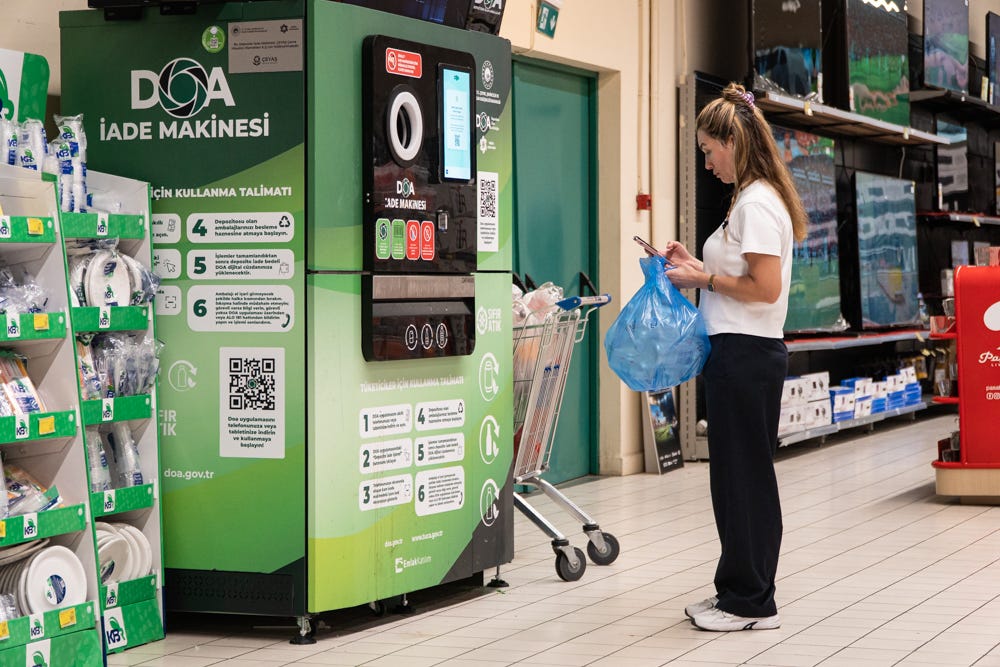
ISTANBUL—It is a scorching August afternoon in Istanbul. At the far end of a spacious, air-conditioned supermarket on the Asian side of the city, a woman stands before a deposit-return machine, holding a bag filled with plastic bottles.
She squints at her phone, struggling to scan the QR code to get the machine to work. Then she sees a message glowing on the electronic screen: “Out of Service.” Disappointed, she walks away. Behind her, a shopping cart packed with empty bottles sits abandoned beside the machine.
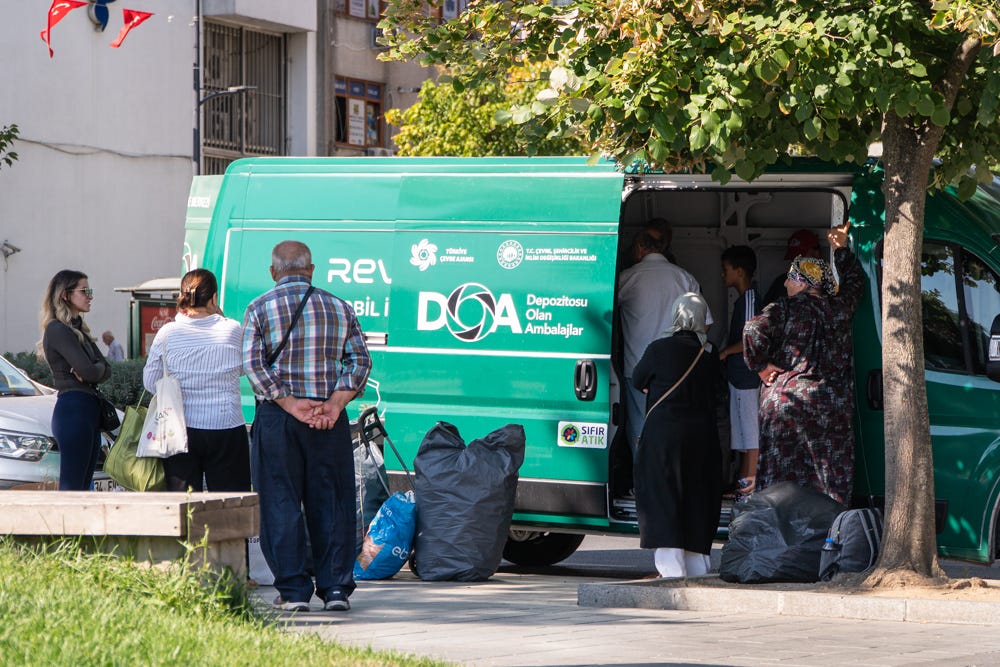
Since July 1, Turkey has rolled out a long-awaited nationwide deposit-return system for single-use beverage containers, known as DOA. Consumers now pay a 1 Turkish lira deposit fee—about 0.02 USD—when buying plastic bottles, glass bottles, or aluminum cans, which they can reclaim by returning the containers to specific collection points.
The returned containers are then sent to select recycling plants, where they are segregated, pressed into cubes and resold for further processing. The country is estimated to go through about 25 billion single-use beverage containers annually.
“The era of ‘buy, use, throw away’ is over. The era of ‘buy, use, recycle’ has begun,” Murat Kurum, Turkey’s Minister of Environment, Urbanization and Climate Change, said a month before the launch.
The deposit scheme is part of Turkey’s Zero Waste program aimed at transitioning the country to a circular economy by radically reducing waste generation and scaling up recycling capabilities. Since the initiative was introduced by First Lady Emine Erdoğan in 2017, the country has reported major increases in waste recovery and economic gains from improved waste management.
“Through the projects and practices launched as part of the Zero Waste Movement, we have contributed exactly 365 billion Turkish Liras to our economy and recycled 90 million tons of waste,” Turkish Pres. Recep Tayyip Erdoğan said during a speech at the Zero Waste Forum Gala Dinner on June 7.
But experts, activists and union members tell Turkey recap a different story. While they commend the country’s ambition to become a zero-waste pioneer, they say progress remains largely on paper. Claimed advances lack transparency and supporting evidence, leading recycling advocates to question the validity of the government’s official waste data.
Disputed numbers
As part of Zero Waste, Turkey has invested in new recycling infrastructure and rolled out public awareness campaigns, community collection initiatives, and legislation to tackle solid waste at its source.
Turkish officials say these efforts have helped drive a remarkable surge in the country’s municipal waste recovery rate—or the amount of household trash diverted from landfills for recycling or reuse.
Over the course of a few years, Turkey rose from the bottom of the OECD’s waste management rankings. According to ministry statements, the country now recovers about 37 percent of its 32 million tons of annual household waste—up from just 13 percent—bringing it closer to the European Union average of about 48 percent.
Pushing for further progress, Environment Min. Kurum recently pledged that Turkey would raise its recycling rate to 80 percent by 2053 while cutting overall waste generation by 50 percent.
However, some sector experts believe these numbers are heavily distorted. According to Berk Butan, the social and economic systems campaign lead at Greenpeace Turkey, the nation’s current recycling facilities are incapable of suddenly handling such large volumes. Moreover, the figures often cited refer to recovery, a much broader category than recycling, Butan added.
“The official ‘recovery’ rates are artificially inflated because the government includes toxic waste-to-energy incineration within the definition of recovery,” Butan told Turkey recap.
He said that some of Turkey’s incineration plants burn tens of thousands of tons of plastic, releasing greenhouse gases and hazardous ash, while being counted as recycling.
In addition, a 2025 report from the European Environmental Agency (EEA) stated that Turkey’s apparent rise in waste recovery and recycling rates is mostly due to new ways of calculating and tracking the data, rather than an improvement in recycling practices.
Butan noted that while the state “proudly” reports a 37 percent recovery rate, independent evaluations from the World Bank estimate Turkey’s actual recovery rate was 12 percent in 2022.
Waste awareness
Still, Turkey’s recent zero-waste efforts have received global acclaim, garnering prestigious international awards and becoming part of the UN’s global sustainable development agenda. Waste management is also expected to take center stage at the COP31 Climate Summit, to be held in Antalya in November this year.
“There are many ways to combat climate change, but Zero Waste is the bridge that connects all those ways,” First Lady Erdoğan stated during her opening address at the Zero Waste Forum 2026 in Istanbul.
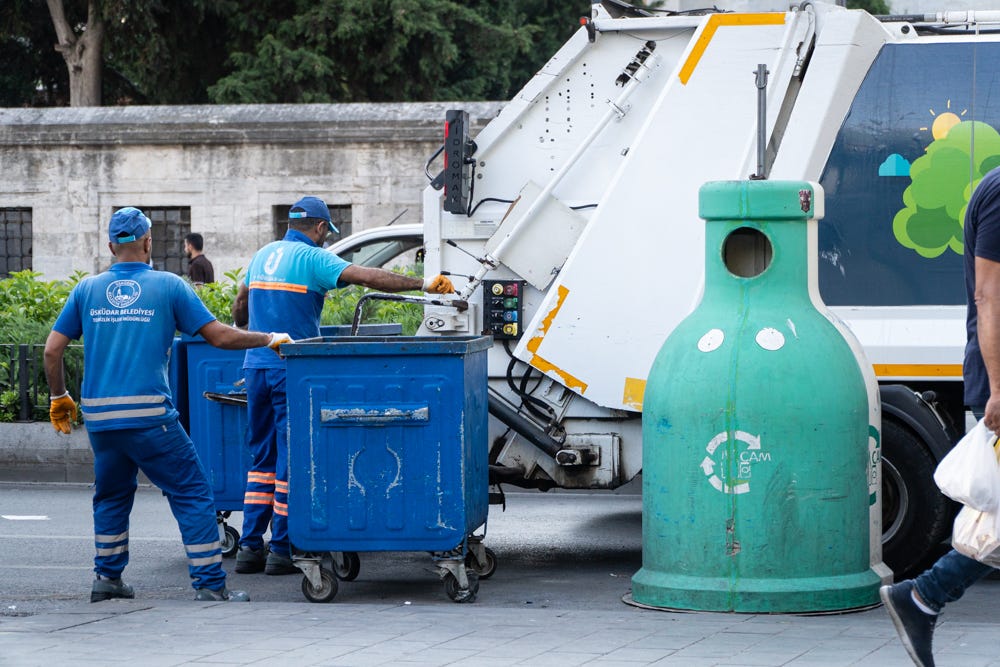
According to Emrah Bilge, general manager of the Take Care of Your Waste Foundation, programs such as Zero Waste have successfully raised public awareness in recent times, with more people becoming conscious of their waste footprint. However, this awareness does not always translate into sufficient changes in daily behavior, Bilge noted.
“It’s like knowing smoking is harmful but continuing to smoke,” Bilge told Turkey recap, adding that Turkey’s overall waste generation has increased over the years, largely in line with the country’s economic growth.
While industry lobbyists delayed the rollout of Turkey’s new deposit system for years, Bilge was pleased it had finally launched. He believes the system’s full implementation will help accelerate recycling by financially incentivizing people to return their litter.
“If you ask me, the deposit system is actually the most effective tool for proper waste management,” Bilge told Turkey recap. “Even someone who is not environmentally conscious may participate in the system simply for their own economic benefit.”
At the same time, Bilge warned that recycling is not the environmental silver bullet it is often made out to be.
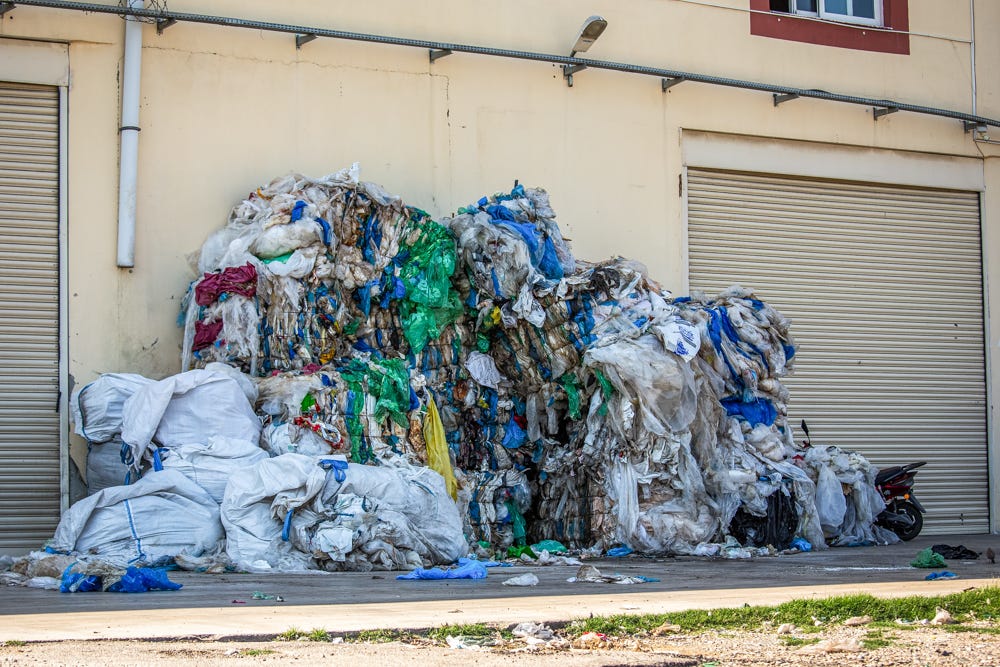
“A recycling facility, just like any other factory, consumes energy, uses water, and releases carbon emissions,” Bilge said. “It’s not some pink, pollution-free plant.”
Recycling plants
Besides its environmental costs, Turkey’s recycling and waste collection remain largely dependent on informal labor despite recent formalization efforts under the Zero Waste program, explained Ali Mendillioğlu, the head of Turkey’s Recycling Workers Union.
Waste pickers pushing large carts through the streets and scouring trash bins for plastic and paper are a common sight throughout much of the country. Their collected materials eventually make their way to one of Turkey’s many recycling plants.
These have become notorious in recent times for taking on heaps of more lucrative foreign trash and relying on society’s most vulnerable and marginalized populations to churn a profit, Mendillioğlu said. Many of them are young males, treated as disposable hands to do harsh and dangerous work for little pay.
“The only way to make money from this job is not paying rent,” Mendillioğlu told Turkey recap. He added that, to save earnings, recycling workers usually leave their families behind and live collectively inside recycling facilities.
With little to no occupational health and safety measures, workers in these plants are constantly exposed to volatile compounds and toxic chemicals, leaving them prone to various respiratory diseases. Data compiled by Turkey’s Health and Safety Labor Watch (ISIG) indicates that, on average, two people are crushed, cut, or burned to death in the recycling sector each month.
“This work involves an incredibly heavy physical workload, both in street collection and inside sorting facilities,” Mendillioğlu said.
Like others, he is not impressed by the new deposit system, arguing that the current number of installed deposit-return machines, about 2,500, is far too few. He also said most have been placed in middle- and upper-class areas where he believes residents have scant interest in stashing bottles to later retrieve a few liras.
“Nobody hoards [bottles] at home for a week or 10 days to go to those machines for 20 or 30 liras,” Mendillioğlu told Turkey recap. As a result, he argued, the deposit fee is essentially an additional consumer tax.
About six weeks into the scheme, over 100 million bottles had been returned, the Environment Minister said on August 13. This amounts to less than two days’ worth of Turkey’s average consumption of beverage containers.
Landfilled
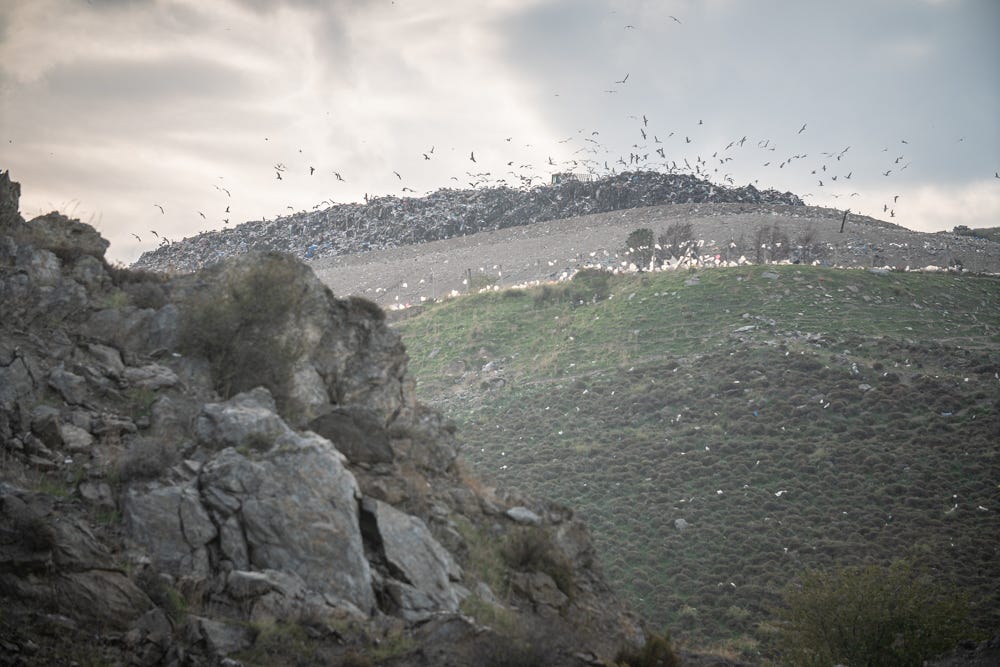
The bottles that bypass these machines might instead end up in one of the country’s nearly 100 landfills, vast pits where garbage is compacted, buried and left to decompose, often with detrimental impacts for the surrounding environment.
This is a cost well known to Dursun Ali Kazar. For decades, the former village head watched heaps of waste get trucked in every day and dumped on the hills above his home near Izmir, in western Turkey.
The controlled sanitary landfill in Harmandalı was Izmir Municipality’s first and main disposal site when it was established in 1992. As Turkey’s economy grew, cities expanded and consumption surged, requiring new solutions to address the country’s hazardous makeshift dumping grounds.
Harmandalı’s facility was considered a major advancement at the time, with gas collection and flaring systems to prevent odors and explosions.
But as Izmir’s households continued to produce more trash, Harmandalı’s garbage pile grew far beyond its intended limits, with devastating consequences downstream, Kazar explained.
A foul stench started to engulf the village and toxic runoff began to seep into streets and waterways. Pollution from the dump decimated local olive groves and the once-abundant cattle herds on the hillsides vanished. Eventually, the villagers began to fall ill.
“People can’t breathe. They can’t even open their windows. The children are unable to go to school in a healthy manner,” said Kazar, who for years has been fighting to stop the disposal of waste in Harmandalı.
In 2020, disaster struck. Following a powerful earthquake, severe landslides accelerated near the landfill, which had been planned to close 13 years earlier. The sheer weight of the stored junk caused the ground to give way, tearing apart roads and forcing several families to flee as their homes collapsed.
“Fourteen houses were destroyed because of the garbage,” Kazar told Turkey recap.
Nearly a decade after Zero Waste’s introduction, the facility was finally shut down in early 2026, holding an estimated total of 25 million tons of refuse. For Greenpeace’s Butan, the vast amount of waste still sent directly to the landfills shows that Turkey’s Zero Waste vision is far from being materialized.
Turkey recap is an independent, reader-supported newsletter that helps people make sense of the fast-paced Turkey news cycle. Get in touch at info@turkeyrecap.com.
Subscribe here on Substack (or on Patreon for discount options). Paid subscribers get full access to our recaps, reports, members-only chat and news tracking tools.
We are an affiliate of the Global Forum for Media Development and aim to produce balanced news that strengthens local media by supporting journalists in Turkey.
✅ Typos verify our humanity. All Turkey recap news output is created and fact-checked by people. Find our AI policy in our Code of Ethics.
Diego Cupolo, Editor-in-chief
Emily Rice Johnson, Deputy editor
Yıldız Yazıcıoğlu, Parliament correspondent
Hilmi Hacaloğlu, Political correspondent
Gözde Ocak, Stüdyo recap editor
Demet Şöhret, Social media and content manager

This article is part of a series of reports focusing on Turkey’s climate governance produced with support from the Heinrich Böll Stiftung Turkey Office, and in no way reflects the views of the Heinrich Böll Stiftung.